
Co-Founder & CTO, SnapMenuAI, Inc


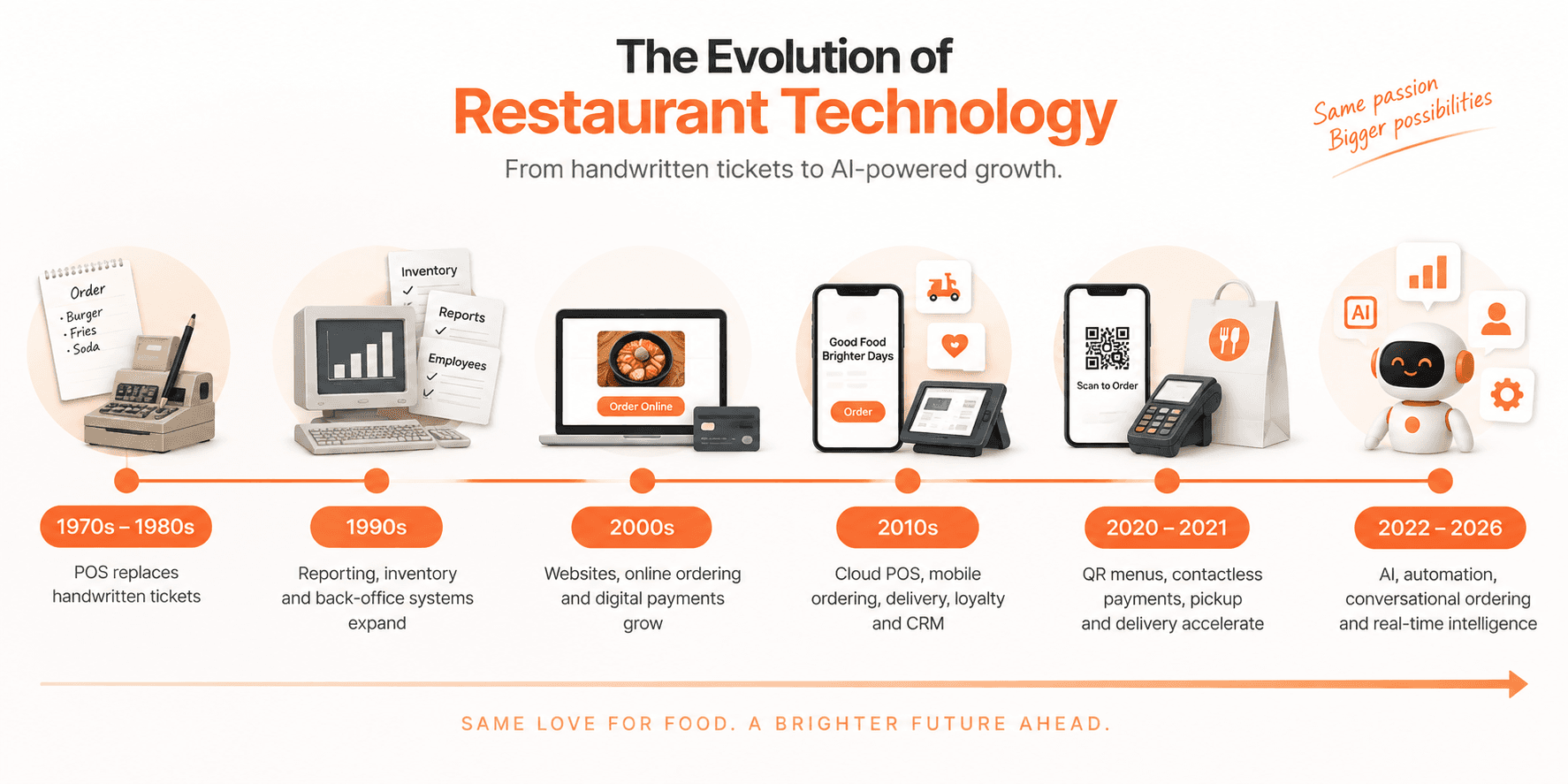
Restaurant technology has evolved through several major stages.
1970s–1980s: POS systems began replacing handwritten tickets, manual calculations, and traditional cash-register workflows.
1990s: Reporting, inventory tracking, employee management, and back-office systems expanded.
2000s: Restaurant websites, online ordering, and digital payments became more common.
2010s: Cloud POS, mobile ordering, delivery platforms, loyalty programs, tablets, and CRM tools became part of everyday restaurant operations.
2020–2021: QR menus, contactless payments, pickup, delivery, and digital ordering accelerated.
2022–2026: AI, automation, conversational ordering, connected guest data, predictive operations, and real-time decision support became much more important.
The biggest change is not simply that restaurants have more technology.
Technology now reaches almost every stage of the restaurant customer and operating journey:
Discover → Engage → Order → Pay → Serve → Learn → Return
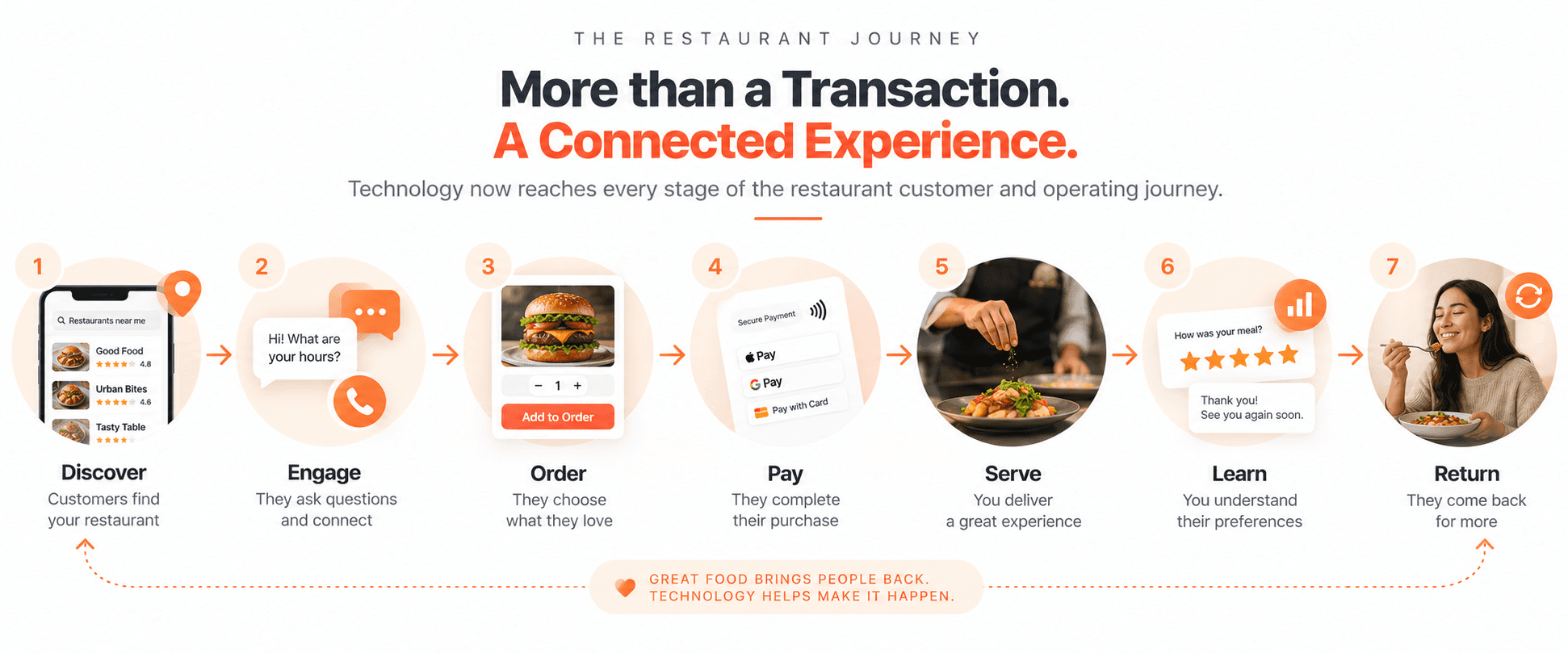
A POS can complete the transaction. But before that transaction happens, the restaurant still needs to attract the customer, answer questions, present the menu, capture the order, and make ordering easy.
After the order, the restaurant still needs to prepare it efficiently, understand the customer relationship, and create a reason for that customer to return.
That broader change is shaping the most important restaurant technology trends in 2026.
For a wider look at the role of artificial intelligence across restaurant operations, read how restaurants are using AI in 2026.
What are the biggest restaurant technology trends in 2026?
The biggest restaurant technology trends in 2026 include AI restaurant management, Voice AI and SMS ordering, direct digital ordering, connected guest data, automated loyalty marketing, smart kitchen display systems, and real-time labor and financial intelligence.
The common direction is clear: restaurant technology is increasingly being used to improve customer access, operational decisions, fulfillment, and repeat business, not only to record transactions.
2026 restaurant technology trend | What it helps restaurants do |
AI restaurant management | Make faster operational decisions |
Voice AI and conversational ordering | Capture customer demand through calls and messages |
Direct digital ordering | Shorten the path from discovery to purchase |
Connected guest data | Build a clearer view of repeat customers |
Automated loyalty marketing | Make promotions more relevant |
Smart kitchen display systems | Improve order routing and kitchen flow |
Real-time intelligence | Monitor demand, labor, costs, and performance sooner |
For restaurant operators, the practical question is not which trend sounds most advanced.
Technology solves an important problem in the restaurant today.
1. AI restaurant management is becoming more practical
One of the clearest shifts in 2026 is the move from basic automation toward AI restaurant management.
CloudKitchens describes AI as an operational copilot that can help manage order flow, optimize kitchen production, and respond to live demand patterns.
For a restaurant manager, that can mean getting faster answers to questions such as:
Is order volume rising faster than expected?
Is one area of the kitchen becoming overloaded?
Are preparation times increasing?
Does staffing need to be adjusted?
Is current demand different from the forecast?
AI does not remove the manager from the decision.
Its value is in surfacing useful information while there is still time to respond.
Financial visibility is becoming more immediate
Maglux Insights highlights a similar development in restaurant financial management.
Instead of depending only on monthly reports, operators can increasingly monitor information such as:
Gross revenue
Aggregator commissions
Estimated cost of goods sold
Current operating performance
That gives operators a chance to spot problems earlier.
If delivery commissions, food-cost estimates, or revenue patterns change significantly, restaurant owners do not necessarily have to wait until the end of the month to notice.
Dynamic pricing is becoming more data-informed
Maglux also describes AI-supported pricing systems that analyze demand, local weather, and competitor activity before recommending changes on delivery platforms.
In examples cited by Maglux, delivery prices increased by 5% to 10% during demand spikes, with reported margin improvements of 4% to 7%.
Those figures are examples from that source, not universal restaurant benchmarks.
The broader trend is that restaurant pricing decisions can increasingly reflect current market conditions rather than remaining completely static.
Human oversight is still important because price also affects customer expectations, perceived value, and brand positioning.
2. Voice AI is addressing a costly phone-order problem
Phone ordering remains an important revenue channel for many restaurants.
According to SnapMenuAI customer data, approximately 45% of orders in the observed restaurant sample came through phone calls.
That makes the phone more than a customer-service channel. It is a direct ordering channel.
The problem is what happens when the restaurant is busy.
Staff may already be:
Serving dine-in guests
Preparing food
Packing pickup orders
Handling payments
Coordinating delivery drivers
Managing kitchen activity
When several calls arrive at the same time, some may ring unanswered, go to voicemail, or be answered too late.
A customer who is already ready to order may simply call another restaurant.
The business problem is therefore not only:
“We missed a phone call.”
It may also be:
“We missed an order that was ready to happen.”
Voice AI can help restaurants capture more of that demand
Maglux identifies multilingual Voice AI as a major restaurant technology trend in 2026.
Restaurant Voice AI can support interactions involving:
Phone orders
Menu questions
Modifiers and add-ons
Item recommendations
Reservation requests
Order information
Multilingual conversations
Staff escalation when needed
SnapMenuAI VoiceAI is designed specifically for restaurant phone conversations.
Depending on restaurant configuration, it can answer incoming calls, understand menu-driven questions, capture supported orders and modifiers, recommend add-ons, support reservations, send payment links and confirmations, and transfer conversations to staff when necessary.
The goal is not to remove staff from hospitality.
It is to make sure routine calls do not automatically become missed ordering opportunities when the restaurant is under pressure.
For a deeper explanation of the customer journey, read AI phone answering for restaurants.
3. SMS ordering is making digital ordering simpler
Messaging is also becoming an ordering channel.
Maglux describes restaurants using WhatsApp for menu browsing, ordering, payment, and tracking. The wider trend is that customers increasingly expect messaging channels to support real actions.
SMS takes that idea into a channel customers already know how to use.
With SnapMenuAI SMS AI, customers can begin an ordering conversation by simply sending a text.
No app download. No website visit. Just simple text.
The customer does not need to:
Install another restaurant app
Create a new account
Search through a website
Navigate several checkout screens
Wait on hold for someone to answer
A conversational SMS journey can move through:
Text → Ask → Choose → Customize → Order → Pay → Confirm
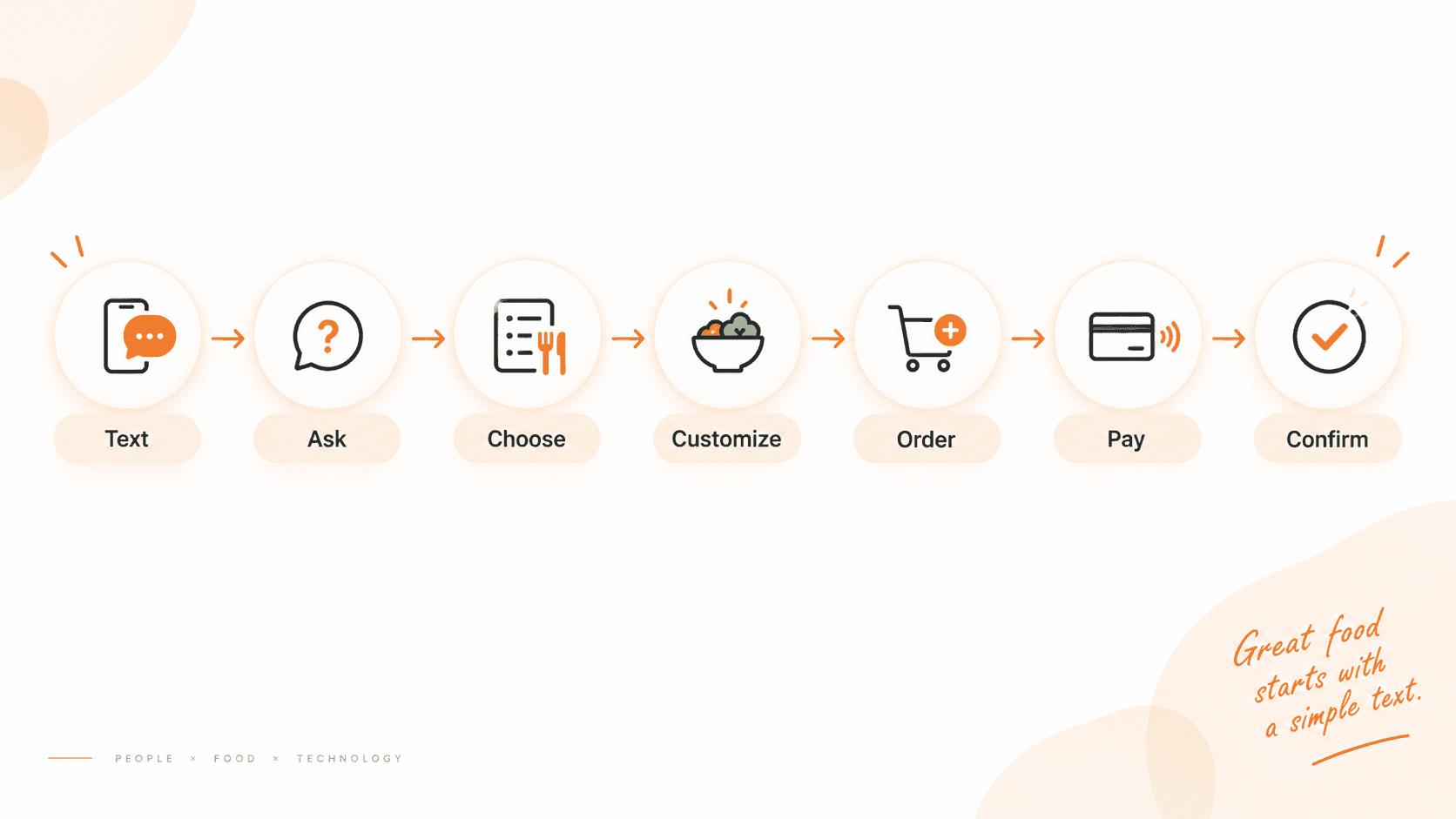
Depending on the restaurant's setup, SMS AI can support:
Restaurant orders
Menu questions
Modifiers and add-ons
Item recommendations
Reservation requests
Payment links
Order confirmations
Multilingual conversations
Human escalation when required
A customer could simply text:
“Can I order two chicken sandwiches for pickup?”
The conversation can then continue through item choices, modifiers, recommendations, confirmation, and supported payment steps.
This is an important part of restaurant digital transformation because digital convenience does not always require adding more interfaces.
Sometimes the better experience is removing steps.
Learn more about SMS AI for restaurant ordering.
4. Direct digital ordering is shortening the path to purchase
Restaurant websites are also becoming more useful.
A traditional restaurant website may show:
Business hours
Address
Phone number
Menu
Photos
Contact information
Those details still matter, but customers increasingly expect to take action from the same experience.
A direct ordering journey can look like:
Search → Restaurant → Menu → Order → Payment → Confirmation
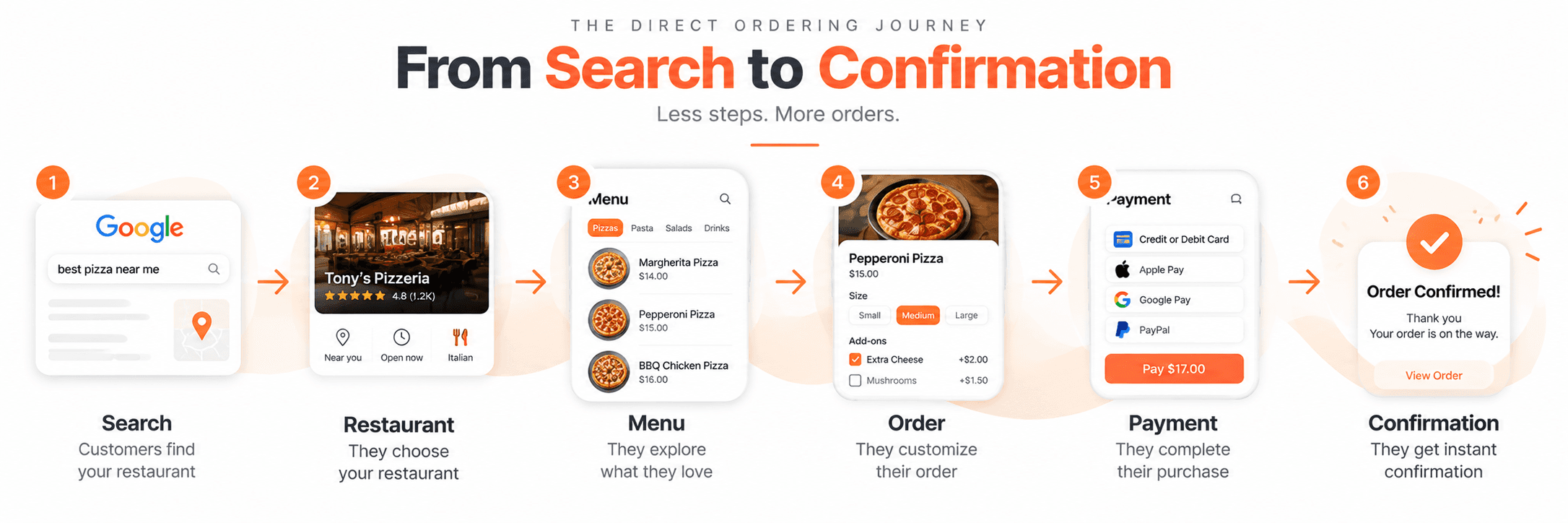
That reduces the gap between discovering the restaurant and placing an order.
Restaurants are supporting multiple ordering paths
Different customers prefer different channels.
A restaurant may receive orders through:
Phone
SMS
Website
QR code
Delivery marketplace
Dine-in service
The goal is not necessarily to replace one channel with another.
It is to give customers practical options while keeping the restaurant operation manageable.
For restaurants building a stronger direct ordering channel, CommerceAI supports restaurant websites, online ordering, QR ordering, menus, reservations, payments, and reporting.
You can also read online ordering for restaurants for a deeper look at direct digital ordering.
Delivery visibility is becoming tied to operational performance
CloudKitchens describes major delivery apps as algorithm-driven ecosystems.
According to its analysis, operational factors such as preparation time and order accuracy can influence restaurant visibility within those platforms.
That creates an important connection.
A kitchen delay is not only a back-of-house issue.
Operational performance can also influence how the restaurant performs in digital discovery environments.
Customer acquisition and restaurant operations are becoming more closely linked.
5. Connected guest data is changing loyalty marketing
Restaurant customers rarely interact through only one channel.
A guest may:
Make a reservation
Dine in
Place a delivery order
Order directly later
Respond to a promotion
Leave a review
If those systems remain disconnected, the restaurant may not recognize that those actions came from the same person.
SevenRooms reports that 74% of dine-in guests later order delivery.
That figure shows why connected guest data matters.
A regular customer can look like several unrelated customers when dine-in, delivery, reservations, and marketing systems do not share enough context.
Automated loyalty marketing is becoming more behavior-based
SevenRooms also reports that only 30% of operators currently target promotions according to guest behavior.
That leaves significant room for more relevant automated loyalty marketing for restaurants.
Restaurants can increasingly use information such as:
Previous orders
Visit frequency
Dining preferences
Reservation history
Delivery behavior
Marketing engagement
to shape future communication.
The goal is not to send more promotions.
It is to avoid treating every customer exactly the same.
A guest who repeatedly orders a particular menu category may be more interested in a related offer than in a generic promotion sent to the entire database.
That moves restaurant loyalty away from basic mass messaging and closer to behavior-informed engagement.
6. Smart kitchen display systems are becoming operational tools
Restaurant technology changes are also happening behind the counter.
Traditional kitchen display systems mainly replaced paper tickets with digital screens.
OrderIt describes newer smart kitchen display systems that can connect order routing, kitchen production, and batch-level inventory information.
A modern KDS can help restaurant teams understand:
Which orders should be prioritized
Which station should receive an item
How kitchen workload is changing
Which ingredients are being consumed
Where shortages may develop
Where waste may be occurring
The change is therefore larger than:
Paper ticket → Digital screen
It becomes:
Order → Routing → Production → Inventory → Operational insight
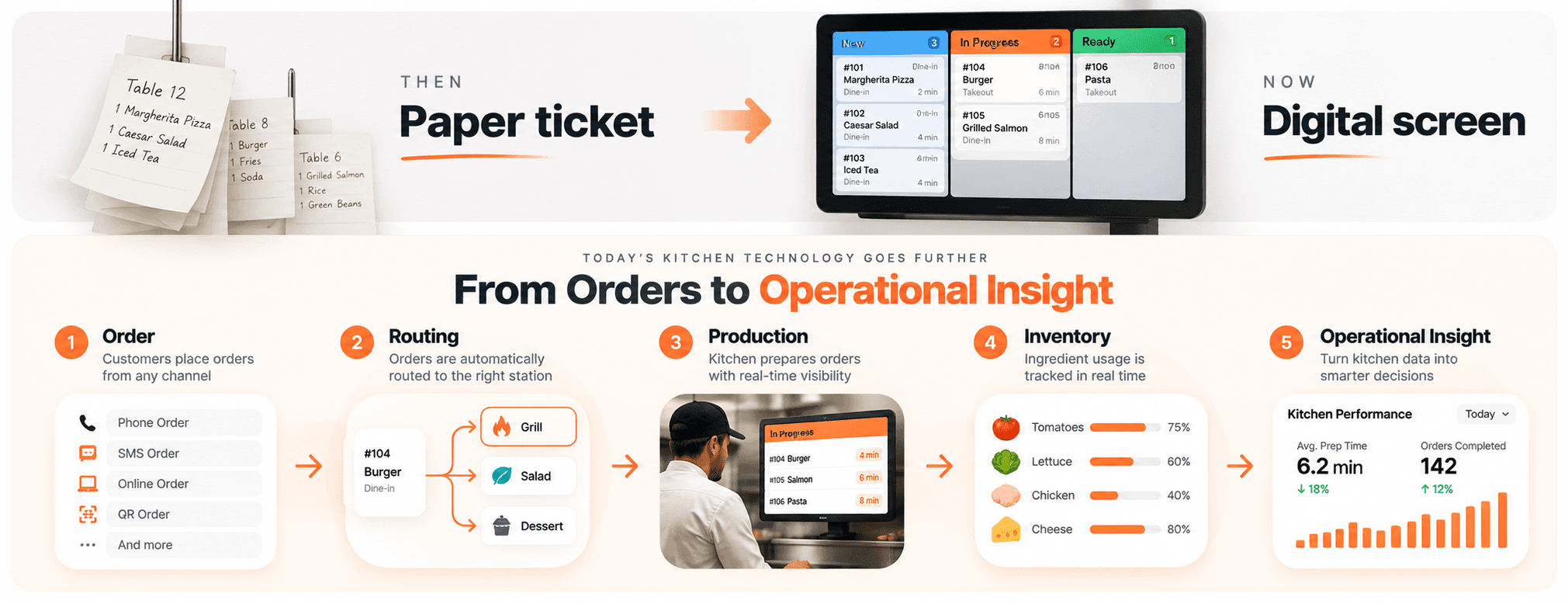
That makes kitchen technology part of restaurant operations management rather than simply an order-display tool.
Structured menu information becomes more important
As ordering channels multiply, menu data becomes more important too.
A restaurant may need the same information across:
Phone ordering
SMS ordering
Website ordering
QR ordering
POS workflows
Delivery marketplaces
That means categories, items, prices, modifiers, add-ons, availability, and other menu information need to remain organized.
MenuBuilderAI helps restaurants digitize and structure menu information for supported workflows.
Accurate menu data may sound like a basic requirement, but it becomes increasingly important when several customer channels depend on the same source information.
7. Real-time labor and financial intelligence are changing management
Restaurant staffing has always depended on expected demand.
What is changing is the ability to compare expectations with what is actually happening during service.
CloudKitchens describes AI systems helping operators reallocate labor based on live demand patterns.
A restaurant may suddenly experience:
Higher pickup demand than expected
Increased delivery volume
Longer preparation times
One kitchen station becoming overloaded
Another area having available capacity
A schedule created earlier in the week cannot anticipate every change.
Real-time operational data gives managers additional context when deciding how to deploy the team.
Technology does not make the people decision.
The restaurant manager still does.
Restaurant reporting is becoming more actionable
Older reporting systems were largely designed to tell operators what happened.
Newer restaurant systems increasingly try to answer:
What is happening now?
and:
What needs attention?
That distinction is important.
Real-time intelligence can support decisions involving:
Labor
Kitchen production
Financial performance
Customer demand
Pricing
Ordering channels
This is one of the most practical ways AI restaurant management is changing everyday operations.
Restaurant digital transformation is about connection
Restaurant digital transformation does not mean adding as many tools as possible.
It means reducing the gaps between the systems customers and employees already use.
SevenRooms illustrates this through reservation management.
Its 2026 research describes restaurants moving away from manually updating availability across separate tablets and channels toward more unified reservation infrastructure.
The same principle applies more broadly:
Discovery → Communication → Menu → Order → Payment → Kitchen → Guest data → Marketing
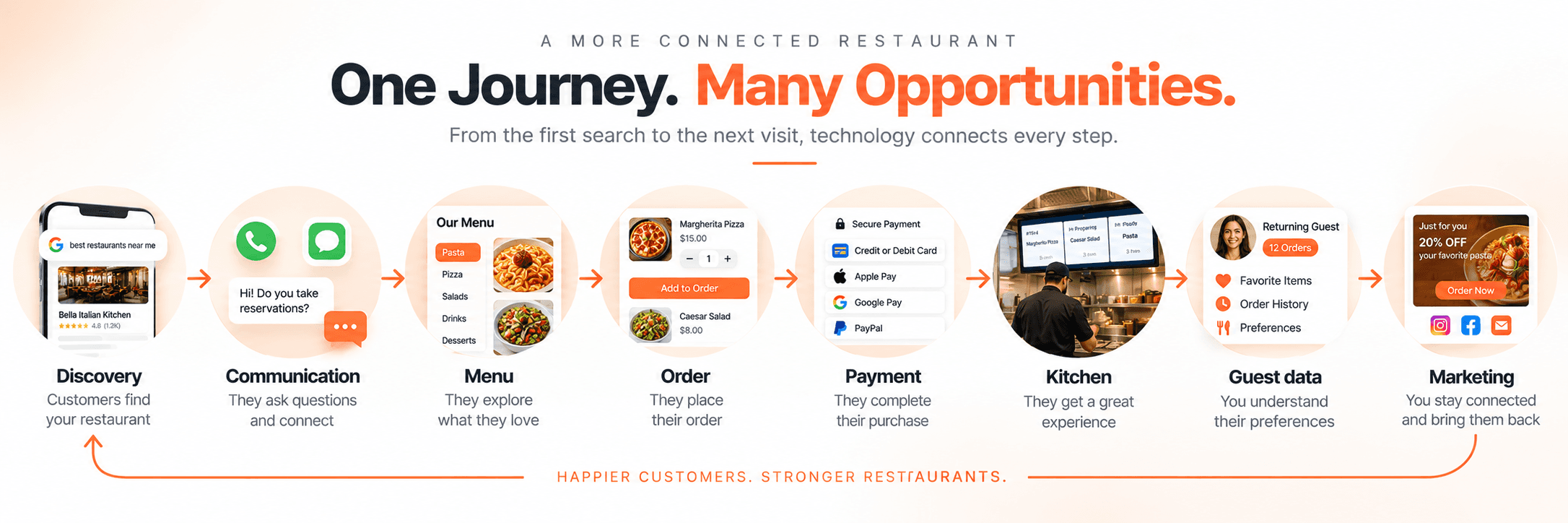
When those stages remain isolated, customers and restaurant employees are forced to bridge the gaps manually.
A useful restaurant digital transformation strategy therefore focuses on reducing unnecessary steps, duplicate work, and disconnected information.
What restaurant technology should operators prioritize in 2026?
Restaurant owners do not need to implement every trend in this article.
A practical approach is to identify where the business currently experiences the most friction.
Start with customer access
Ask:
Can customers find us easily?
Can they view the menu?
Can they reach us during busy periods?
Can they place an order online?
Can they order by text?
Can they make a reservation easily?
If customers are being lost before an order is placed, start there.
Improve operational flow
Then review what happens once the order reaches the restaurant.
Consider:
Order routing
POS workflows
Kitchen production
Menu accuracy
Inventory
Labor visibility
Technology should help the restaurant fulfill demand reliably, not simply create more incoming orders.
Improve repeat-customer engagement
Finally, evaluate what happens after the order.
Ask:
Can we recognize returning customers?
Do we understand what they order?
Can we communicate with them again?
Are promotions relevant?
Do we have a process for encouraging another visit or order?
This creates a simple technology-priority framework:
Customer access → Operations → Retention
Josh Kopel's 2026 guidance follows a similar practical philosophy. He recommends beginning with a modern cloud POS, automated email/SMS marketing, and AI review management.
Kopel reports that this three-tool foundation can drive 15%+ revenue growth, although actual results depend on the restaurant, market, implementation, and execution.
The useful takeaway is not that every restaurant needs exactly the same three products.
It is that technology should be tied to a clear business need.
Where SnapMenuAI fits
SnapMenuAI focuses primarily on customer-facing restaurant technology and is designed to complement existing restaurant POS, payment, and operational systems.
Restaurant need | SnapMenuAI solution |
Handle restaurant phone calls and orders | |
Let customers order by simple text, with no app download or website visit | |
Support website, online, and QR ordering | |
Create structured digital menu information | |
Build restaurant promotional campaigns | |
Get managed marketing support |
The right starting point depends on the restaurant's most important current problem.
A restaurant losing phone orders during busy periods may start with VoiceAI.
A restaurant that wants an easier text-ordering option may use SMS AI.
A restaurant building a stronger direct digital channel may focus on CommerceAI.
A restaurant struggling with menu structure, promotions, or marketing execution may begin elsewhere in the SnapMenuAI suite.
The technology should follow the problem, not the other way around.
What restaurant technology trends in 2026 mean for operators
Restaurant technology is becoming more capable, but a larger technology stack is not automatically a better one.
The important question is whether a system improves a meaningful part of the business.
In 2026, that may mean:
Answering phone demand more consistently
Letting customers order through a simple text
Creating a direct digital ordering path
Understanding repeat guests better
Making loyalty communication more relevant
Improving kitchen visibility
Responding faster to changes in demand
Restaurant operators evaluating a new technology investment should therefore ask:
Where are we currently losing customer opportunities, creating unnecessary work, or making decisions without enough information?
That question provides a stronger starting point than adopting technology simply because it is new.
Build restaurant technology around real customer needs
Customers already move between search, phone calls, SMS, websites, menus, orders, payments, and restaurant marketing.
Your technology should make those interactions easier.
SnapMenuAI helps restaurants address customer-facing needs across AI phone ordering, SMS ordering, direct online and QR ordering, structured menu management, and restaurant marketing.
Explore SnapMenuAI or book a restaurant technology demo to see which solution fits your current restaurant priorities.
Frequently asked questions
These questions address some of the most common search topics related to restaurant technology in 2026.
What are the biggest restaurant technology trends in 2026?
The biggest restaurant technology trends in 2026 include AI restaurant management, Voice AI and conversational ordering, SMS ordering, direct online ordering, connected guest data, automated loyalty marketing, smart kitchen display systems, and real-time operational intelligence.
How is AI being used in restaurant management?
AI is being used to support demand analysis, order flow, kitchen production, labor allocation, pricing recommendations, financial monitoring, customer communication, and other operational decisions. Its role is increasingly focused on helping managers understand current conditions and respond faster.
What is automated loyalty marketing for restaurants?
Automated loyalty marketing uses guest behavior and customer information to make restaurant promotions more relevant. Information such as previous orders, visit frequency, dining preferences, reservations, and marketing engagement can help restaurants determine which messages may be useful to different customers.
What is a smart kitchen display system?
A smart kitchen display system digitally organizes and routes restaurant orders. More advanced systems can also connect production workload, kitchen priorities, and inventory information, giving restaurant teams better operational visibility.
What does restaurant digital transformation mean?
Restaurant digital transformation means using connected technology to improve different parts of the restaurant customer and operating journey. This can include ordering, payments, reservations, kitchen operations, customer data, loyalty, labor, and marketing.