
Co-Founder & CTO, SnapMenuAI, Inc


Running a restaurant in 2026 means making decisions all day.
How much food should you prepare? How many people should you schedule? Which menu items are selling? Who answers the phone when everyone is busy? How do you keep online orders, customer questions, promotions, and daily operations moving at the same time?
This is where AI for restaurants is becoming useful.
Restaurants are using artificial intelligence to help answer customer calls, take orders, understand sales data, forecast demand, support scheduling, manage menus, create marketing content, review customer feedback, and reduce repetitive work.
The important shift is that AI is no longer limited to one part of the restaurant.
It can now support work before service, during service, and after the restaurant closes for the day.
The goal is not to replace restaurant owners, managers, servers, or kitchen teams. It is to give them better tools for tasks that take time, repeat often, or depend on large amounts of information.
How AI supports modern restaurant operations
AI for restaurants is software that uses artificial intelligence to help restaurants understand information, automate repeatable tasks, communicate with customers, support ordering, and make operational decisions.
Restaurant AI can be customer-facing or operational.
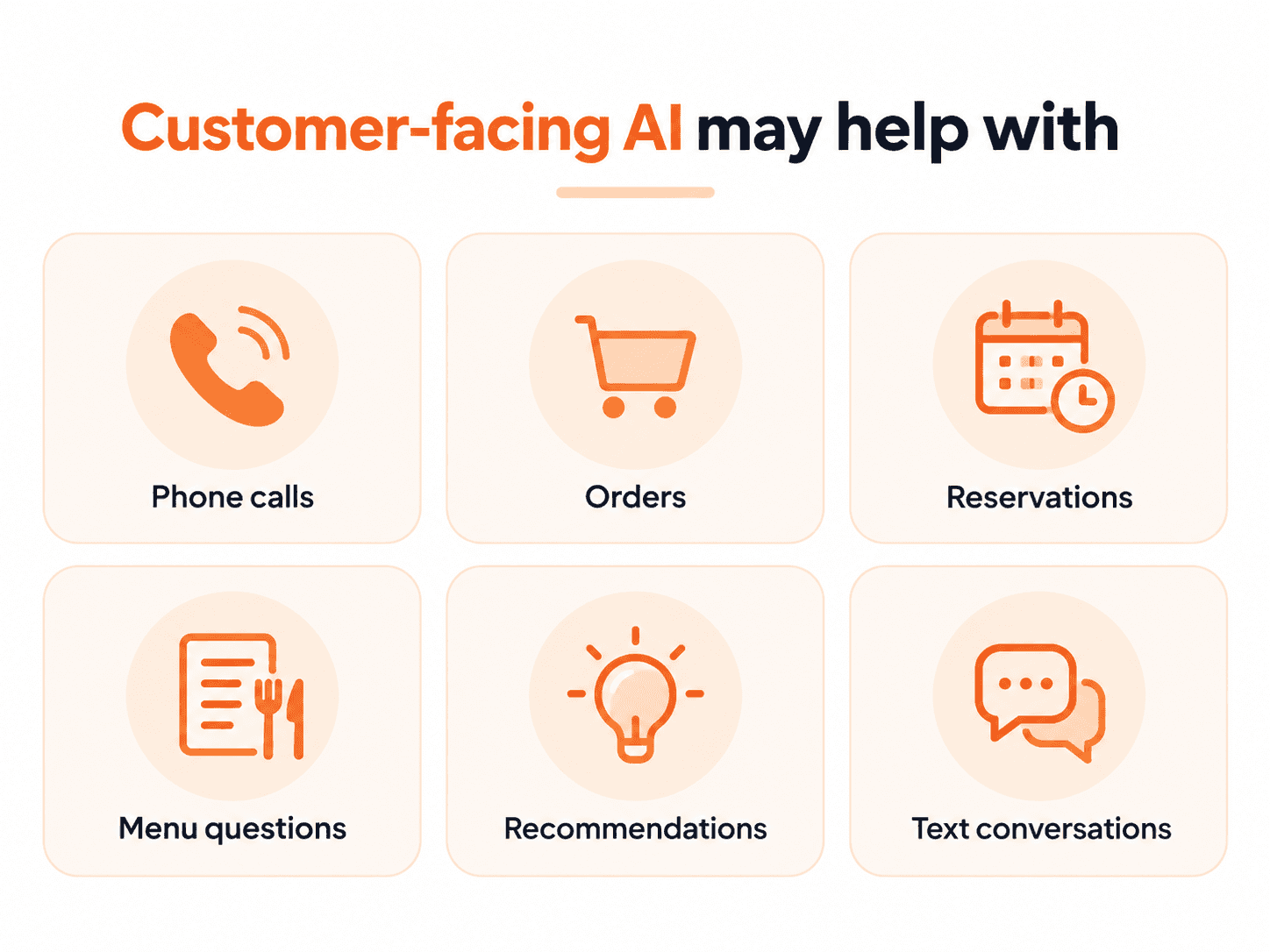
Customer-facing AI may help with:
Phone calls
Orders
Reservations
Menu questions
Recommendations
Text conversations
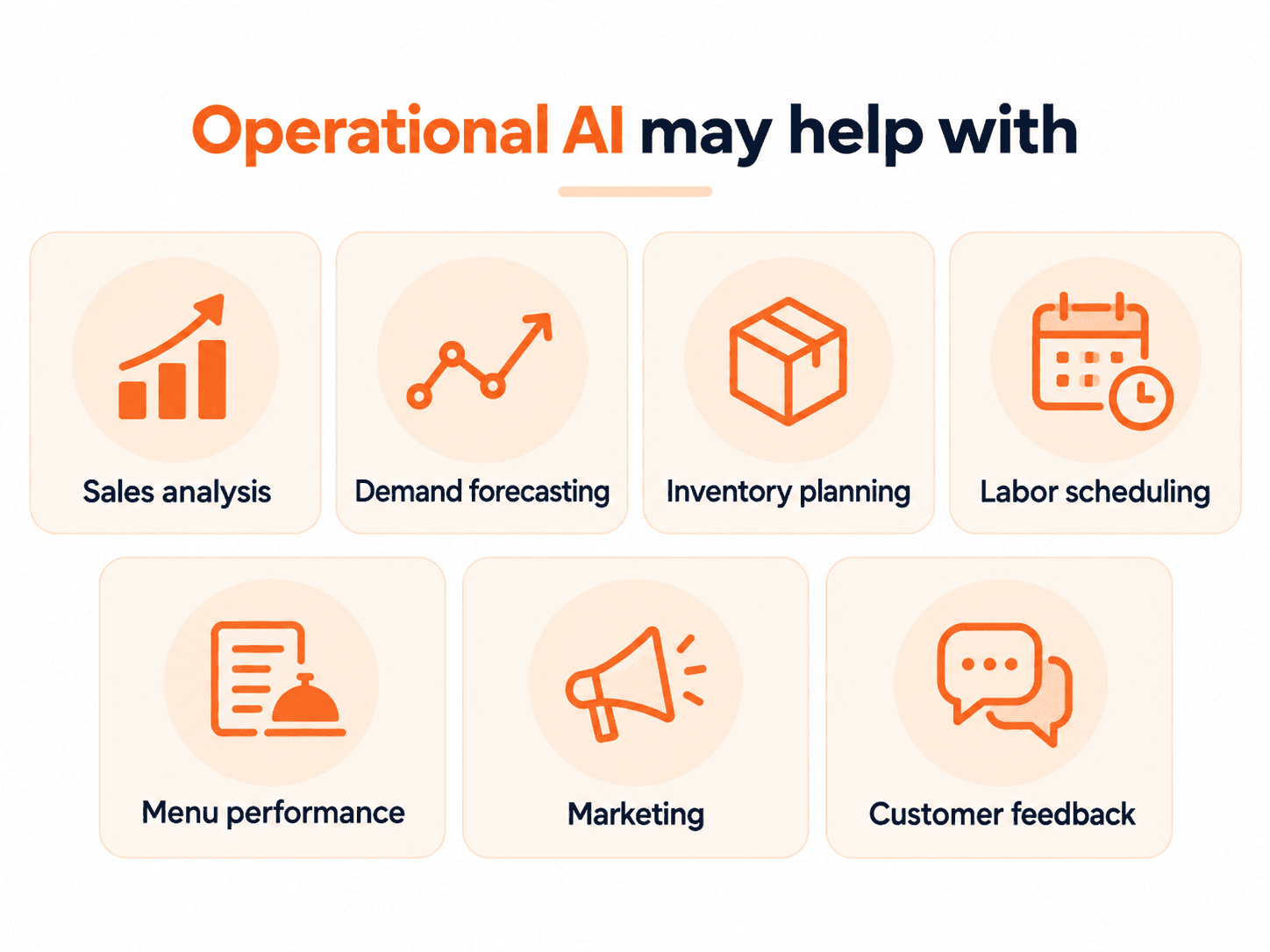
Operational AI may help with:
Sales analysis
Demand forecasting
Inventory planning
Labor scheduling
Menu performance
Marketing
Customer feedback
Many restaurant systems combine AI with traditional automation.
AI can understand patterns, language, or data. Automation usually follows predefined rules.
How are restaurants using AI in 2026?
Restaurant operators are using AI in several practical areas rather than relying on one single “AI restaurant system.”
According to Toast's Q1 2026 Restaurant Trends Report, based on anonymized aggregated data from 125,000 U.S. restaurant locations using Toast IQ between January 1 and March 31, 2026:
47% used it for questions about sales and revenue
34% asked about menu and inventory
32% asked about guests and marketing
26% explored menu optimization opportunities
These figures describe the Toast IQ cohort, not every restaurant in the United States. But they provide a useful picture of how a large group of restaurant operators is already applying AI.
The broader trend is clear: restaurant AI is being used across both daily operations and customer interactions.
Where AI fits into a restaurant day
A simple way to understand restaurant AI is to look at when it helps.
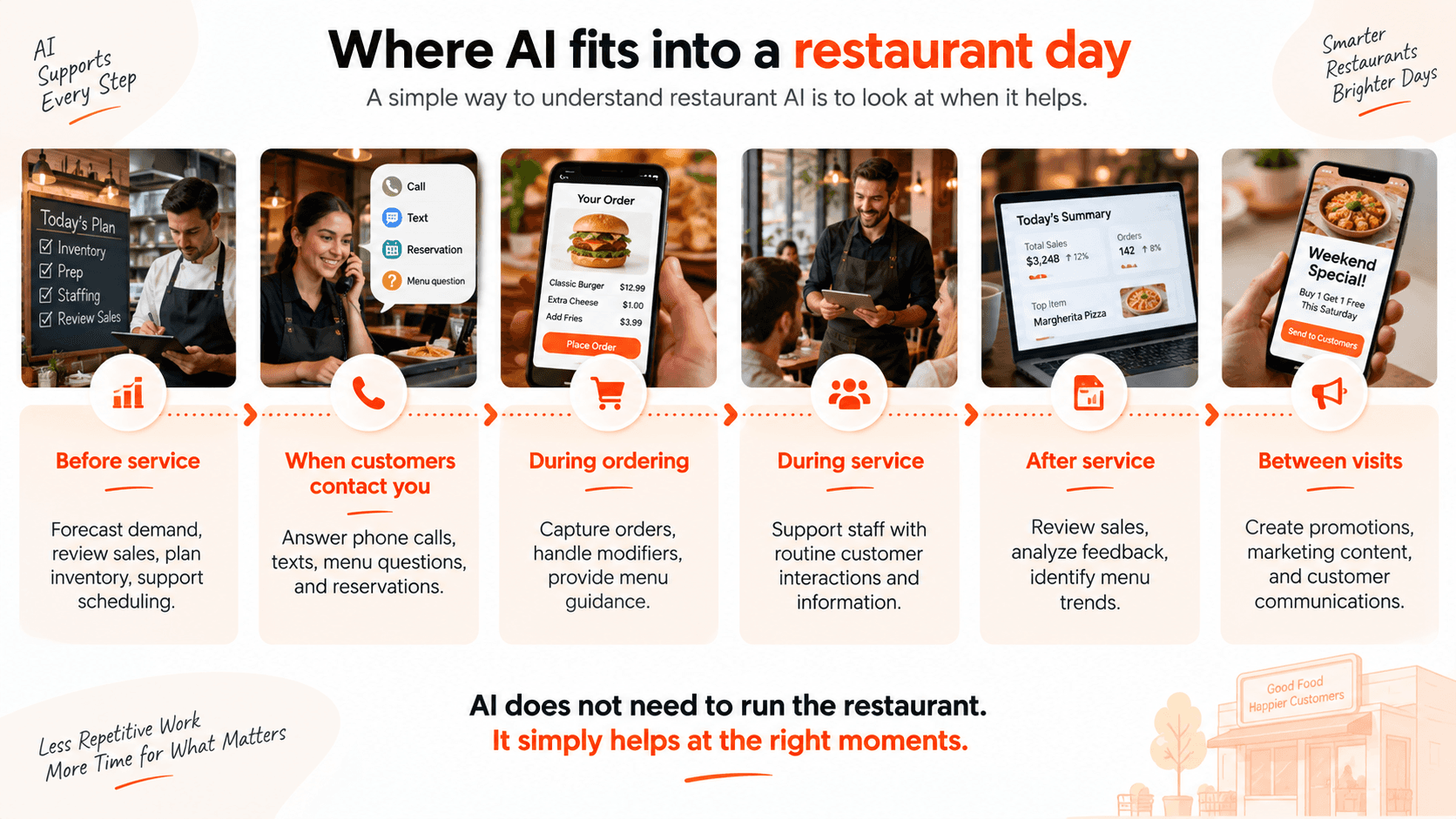
Part of the restaurant day | How AI can help |
Before service | Forecast demand, review sales, plan inventory, support scheduling |
When customers contact you | Answer phone calls, texts, menu questions, and reservations |
During ordering | Capture orders, handle modifiers, provide menu guidance |
During service | Support staff with routine customer interactions and information |
After service | Review sales, analyze feedback, identify menu trends |
Between visits | Create promotions, marketing content, and customer communications |
AI does not need to run the restaurant.
It can simply help at specific points where the team needs faster information or less repetitive work.
1. AI phone answering and phone ordering
The phone is one of the clearest customer-facing uses of restaurant AI.
During a lunch or dinner rush, restaurant employees may already be serving guests, preparing orders, managing pickups, and taking payments.
The phone still rings.
Voice AI for restaurants can help answer supported calls without requiring an employee to pick up every time.
Depending on the system and configuration, restaurant Voice AI can help with:
Phone orders
Menu questions
Modifiers
Reservations
Restaurant information
Multilingual conversations
Payment links
Confirmations
Staff escalation
This is particularly useful because a customer calling a restaurant may already be close to placing an order.
An unanswered call can therefore be more than a missed conversation. It may also be a missed order opportunity.
Read more about how AI phone ordering works for restaurants.
2. Sales analysis and restaurant reporting
Restaurant owners already have sales information.
The harder part is finding the answer they need quickly.
AI can help operators ask questions about restaurant performance in normal language instead of manually searching through several reports.
Useful questions might include:
Which days had the highest sales?
Which items sold less this week?
How did this month compare with last month?
Which locations performed differently?
Where are costs moving in the wrong direction?
AI does not replace financial judgment.
It can make restaurant data easier to explore and understand.
This is particularly useful for multi-location operators dealing with information from several systems. Your Tenzo reference similarly emphasizes using AI to analyze connected operational data while keeping final judgment with the restaurant team.
3. Demand forecasting and inventory planning
Restaurants constantly make decisions about how much food they will need.
Too much inventory can create waste.
Too little can leave the restaurant without an important ingredient during service.
AI forecasting tools can use historical restaurant information such as sales patterns, seasonality, and other available data to estimate future demand.
Restaurants can use those forecasts to support decisions around:
Ingredient purchasing
Preparation quantities
Stock levels
Busy periods
Staffing needs
The quality of the forecast depends on the quality and relevance of the data available to the system.
4. Staff scheduling and labor planning
Restaurants often experience very different staffing needs depending on the day and time.
AI-supported scheduling tools can analyze patterns such as historical demand and busy periods to help managers plan staffing.
The purpose is not to allow software to make every staffing decision.
Managers still understand important details the system may not know, including employee experience, availability, special events, training needs, and what is happening inside the restaurant.
AI provides another source of information for the decision.
5. Menu management and menu optimization
A restaurant menu contains much more information than item names and prices.
It may include:
Categories
Sizes
Modifier groups
Add-ons
Combos
Ingredients
Descriptions
Dietary information
AI can help restaurants organize and digitize this information.
It can also help operators review menu performance data to identify items that may deserve more attention, changes, or further analysis.
Structured menu information becomes even more important when the same menu needs to support POS systems, websites, QR ordering, phone ordering, and text ordering.
6. Restaurant marketing and content creation
AI is also being used to reduce the time required to plan and create restaurant marketing.
Common uses include:
Social media captions
Promotional ideas
Email content
Restaurant posters
Seasonal campaigns
Event promotions
Menu descriptions
Review summaries
AI can produce a useful starting point, but restaurants should still review content before publishing it.
Brand voice, prices, offers, dates, menu availability, and local details still need human verification.
7. Customer feedback and reviews
Restaurants receive customer feedback from many places.
Reading every comment manually can make it difficult to see larger patterns.
AI can help summarize feedback and group recurring topics.
For example, an operator might identify repeated comments around:
Wait times
Food quality
Service
Particular menu items
Pickup experiences
Ordering problems
That information can help restaurant managers decide which issues deserve closer attention.
AI should help organize the feedback. The restaurant team still needs to understand why the problem happened and what should change.
8. SMS and digital ordering
AI is also changing how customers interact with restaurants outside a traditional phone call.
Conversational SMS can allow customers to ask questions and place orders through text.
Digital restaurant experiences can also support:
Website ordering
QR ordering
Reservations
Menu browsing
Payment workflows
The value is giving customers more convenient ways to interact with the restaurant while keeping the ordering experience connected to accurate menu information.
What are the benefits of AI for restaurants?
The value of AI depends on the problem being solved.
Potential benefits include:
Faster access to restaurant information
Fewer repetitive staff tasks
Better support during busy periods
More ways for customers to order
Easier menu management
Faster analysis of restaurant data
More consistent marketing activity
Better visibility into recurring customer feedback
Restaurant AI works best when there is a clearly defined problem first.
Buying an AI tool simply because it uses AI is not a strategy.
What are the limitations of restaurant AI?
AI can help with many restaurant tasks, but it has clear limits.
Your restaurant still needs people to provide:
Hospitality
Judgment
Leadership
Food preparation
Exception handling
Sensitive customer conversations
Operational context
AI is also only as useful as the information available to it.
If menu information is wrong, the system may use the wrong information.
If restaurant data is incomplete, the analysis may also be incomplete.
If an integration is unavailable, the restaurant may need a different workflow.
The strongest approach is to use AI for well-defined tasks while keeping people responsible for important decisions and customer experiences.
This reflects a consistent theme across the restaurant AI references you provided: AI can support forecasting, operations, customer interactions, and analysis, but it should not replace restaurant judgment or be treated as a universal solution.
How should a restaurant start using AI?
Restaurants do not need to automate everything at once.
Start with one clear problem.
1. Identify where time or opportunities are being lost
Ask:
Are phone calls being missed?
Are staff answering the same questions repeatedly?
Is menu management difficult?
Is restaurant marketing inconsistent?
Is reporting taking too long?
Is forecasting difficult?
2. Choose AI for that specific problem
Evaluate solutions based on what the restaurant actually needs.
Do not choose a platform only because it has the longest feature list.
3. Check the restaurant workflow
Understand:
What information the AI needs
Which systems it must connect with
Who maintains the data
When staff should take over
What happens when the AI cannot complete a task
4. Measure the result
Track something relevant to the original problem.
That might include:
Calls handled
Orders completed
Staff interruptions
Time spent on a task
Menu-update effort
Campaign consistency
Forecast accuracy
Then decide whether expanding AI into another part of the restaurant makes sense.
Where SnapMenuAI fits
SnapMenuAI focuses on AI and digital tools for restaurant customer interactions, ordering, menus, and marketing.
Restaurant need | SnapMenuAI solution |
Phone calls and phone ordering | |
Conversational text ordering | |
Website, online, and QR ordering | |
Structured menu digitization | |
Restaurant marketing workflows | |
Managed marketing support |
The goal is not for every restaurant to use every product.
The better approach is to identify the restaurant's current problem and start with the capability that addresses it.
For restaurants specifically exploring phone automation, see the guide to the best AI phone ordering systems for restaurants.

What AI means for restaurants in 2026
AI in restaurants is becoming less about experimentation and more about specific jobs.
Answer the phone.
Understand yesterday's sales.
Forecast tomorrow's demand.
Organize a menu.
Help a customer place an order.
Create the next promotion.
Find a pattern hidden inside restaurant data.
Those are practical uses restaurant owners can evaluate.
The best restaurant AI strategy is not to automate everything. It is to use AI where it makes a real part of the restaurant easier to manage.
Explore restaurant AI with SnapMenuAI
If you are evaluating AI for phone ordering, text ordering, digital commerce, menu management, or restaurant marketing, explore how SnapMenuAI can fit alongside your existing restaurant operation.
Frequently asked questions
What is AI for restaurants?
AI for restaurants is software that uses artificial intelligence to support tasks such as customer calls, ordering, forecasting, reporting, menu management, scheduling, marketing, and customer communication.
How are restaurants using AI in 2026?
Restaurants are using AI for sales analysis, demand forecasting, inventory planning, phone ordering, customer questions, scheduling, menu optimization, marketing, review analysis, and digital ordering.
Can AI answer restaurant phone calls?
Yes. Restaurant Voice AI can handle supported phone conversations such as orders, menu questions, restaurant information, reservations, and configured call escalation.
Can restaurants use AI for ordering?
Yes. AI can support ordering through channels such as phone calls, text conversations, websites, and other digital ordering experiences, depending on the platform and integrations.
Can AI help restaurants manage menus?
Yes. AI can help organize and digitize menu information, including categories, items, modifiers, descriptions, and other structured menu data.
Can AI help with restaurant marketing?
Yes. Restaurants can use AI to help plan campaigns, draft promotional content, create social media material, summarize customer feedback, and support marketing workflows.
Does AI replace restaurant employees?
No. AI is most useful for repeatable tasks, information processing, and structured customer interactions. Restaurant employees remain essential for hospitality, judgment, leadership, food preparation, and situations requiring personal attention.
What should a restaurant automate first?
Start with the problem that creates the most repeated work or missed opportunities. For one restaurant that may be unanswered phone calls. For another, it may be reporting, menu management, inventory planning, scheduling, or marketing.