
Co-Founder & CTO, SnapMenuAI, Inc
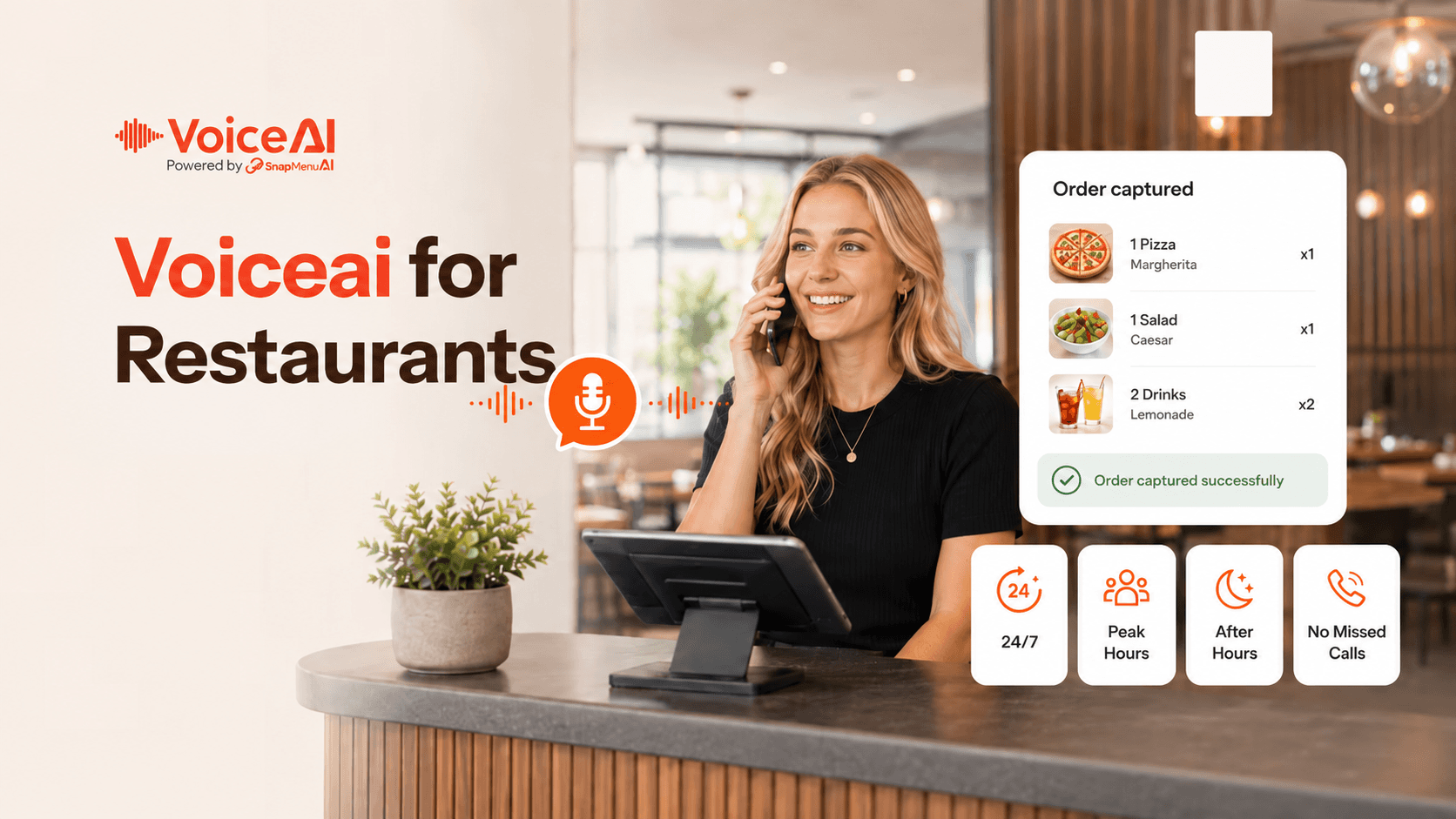


Restaurant phones rarely ring at a convenient time.
A customer may call while employees are helping guests, packing takeout orders, processing payments, or working with the kitchen. The caller may want to place an order, ask about the menu, make a reservation, or simply check whether the restaurant is open.
Voice AI helps restaurants handle these incoming phone conversations using natural spoken interaction. It can take phone orders, answer menu questions, support reservations, recommend relevant add-ons, send payment links, support multiple languages, and transfer calls to staff when human help is needed.
SnapMenuAI VoiceAI is designed specifically around these restaurant phone conversations.
What is Voice AI?
Voice AI is technology that allows a phone system to understand spoken requests and respond conversationally instead of relying only on recorded messages or keypad menus.
In a restaurant, Voice AI can use configured restaurant information such as:
Menu items
Prices
Sizes
Modifiers
Add-ons
Restaurant hours
Pickup and delivery information
Reservation rules
Supported languages
Call-transfer rules
This allows the phone experience to reflect the restaurant's actual menu and operating process.
Restaurant Voice AI is broader than phone ordering alone. Customers may call to order food, ask a question, make a reservation, or reach a member of staff.
What can Voice AI handle on a restaurant call?
Voice AI can support many of the routine conversations restaurants already handle by phone.
Customer need | How Voice AI can help |
|---|---|
Place an order | Capture menu items, quantities, sizes, and configured options |
Customize an order | Handle available modifiers, add-ons, and special instructions |
Ask about the menu | Respond using configured restaurant information |
Make a reservation | Support configured reservation requests |
Check restaurant information | Answer questions such as hours, location, or pickup details |
Add something to an order | Recommend relevant sides, drinks, desserts, or other configured items |
Complete payment | Send a supported secure payment link |
Speak another language | Continue in supported configured languages |
Talk to an employee | Transfer or escalate the call based on restaurant rules |
The important point is that Voice AI should work from restaurant-specific information, not generic answers.
Can Voice AI take restaurant phone orders?
Yes. Voice AI can take restaurant phone orders by understanding what the customer wants and collecting the information required to complete the order.
That may include:
Menu item
Quantity
Size
Toppings
Modifier selections
Add-ons
Special instructions
Pickup or delivery information
If the customer leaves out a required choice, the system can ask for the missing information before the order moves forward.
For example, if a menu item requires the customer to choose a size or side, the system can ask for that selection rather than submitting an incomplete order.
For a deeper look at the ordering workflow, read AI Phone Ordering for Restaurants.
How does Voice AI know what is on the menu?
Restaurant Voice AI works best when it has accurate, structured menu information.
The menu data may include:
Categories
Item names
Descriptions
Prices
Sizes
Modifier groups
Add-ons
Availability
Preparation information
This helps the system understand what customers can actually order.
If a customer asks for an option that is not available for a particular item, the system should not simply assume that request can be fulfilled.
Accurate menu information is therefore an important part of the Voice AI experience.
Can Voice AI handle modifiers and custom orders?
Yes, when modifiers and available choices are properly configured.
Restaurant phone orders often include requests such as:
Extra toppings
Removing an ingredient
Changing the size
Choosing a side
Adding sauces
Selecting preparation options
Adding special instructions
A restaurant-focused Voice AI system should understand which options belong to each item and ask for clarification when required information is missing.
Restaurants evaluating Voice AI should test the system with the kinds of orders customers actually place, including more detailed orders, not only simple menu items.
Can Voice AI answer menu questions?
Yes. Voice AI can answer supported menu questions using the restaurant's configured information.
Customers commonly call to ask:
What comes with an item?
What sizes are available?
Can a side be changed?
Is there a vegetarian option?
What ingredients are listed?
How much does an item cost?
Is an item available?
This can reduce the number of routine questions that require an employee to stop what they are doing and answer the phone.
Dietary and allergen questions require additional care. Voice AI should rely only on information the restaurant has provided and allow the customer to reach staff when additional confirmation is needed.
Can Voice AI help with restaurant reservations?
Yes, Voice AI can support reservation requests when the restaurant has configured the appropriate reservation workflow or supported integration.
A reservation conversation may involve:
Date
Time
Party size
Customer information
Availability
Supported reservation changes
Customers do not think about whether they are entering an ordering system or reservation system. They simply call the restaurant and explain what they need.
Voice AI can identify the purpose of the call and respond according to the restaurant's configured workflow.
Can Voice AI support restaurant upselling?
Voice AI can recommend relevant menu additions during an ordering conversation.
Depending on the restaurant's menu, that may include:
Drinks
Sides
Desserts
Toppings
Sauces
Other compatible add-ons
Recommendations should fit naturally with the customer's order.
The purpose is not to make every phone call longer. It is to give customers relevant options while helping the restaurant present add-ons more consistently.
How do payments work with Voice AI?
Payment handling depends on the restaurant's setup and supported integrations.
With SnapMenuAI VoiceAI, a restaurant can configure workflows that send the customer a secure payment link by SMS.
This lets the customer continue from the phone conversation to payment without requiring restaurant staff to manually manage every payment step.
The customer can also receive confirmation information through SMS depending on the configured workflow.
Restaurants should verify how payment information is handled within their specific payment and integration setup.
Can Voice AI connect with a restaurant POS?
Voice AI can connect with supported restaurant systems depending on the integration and configuration.
A connected ordering workflow may include information such as:
Customer details
Menu items
Quantities
Modifiers
Special instructions
Order total
Payment status
Preparation information
POS compatibility should be one of the questions restaurants ask before selecting a Voice AI provider.
Restaurants comparing multiple options can also review our guide to the best AI phone ordering systems for restaurants.
How does Voice AI help during busy restaurant hours?
Voice AI gives restaurants another way to handle incoming calls when employees are already occupied with customers and operations.
During a rush, employees may already be:
Serving dine-in guests
Preparing food
Packing takeout orders
Processing payments
Managing delivery drivers
Working at the counter
The phone is another customer asking for attention.
Voice AI can handle supported routine calls while employees continue working on tasks that require their physical presence inside the restaurant.
This does not mean every call should be automated. Calls requiring judgment or personal attention should still have a path to staff.
Can Voice AI answer calls after hours?
Voice AI can provide configured call coverage outside normal restaurant hours.
Customers may call after closing to:
Check tomorrow's hours
Ask about the menu
Get pickup or delivery information
Request a future reservation
Find out when ordering will be available again
The exact after-hours experience should follow the restaurant's own schedule and operating rules.
This can give callers more useful information than voicemail alone.
Can Voice AI speak with customers in different languages?
Voice AI can support multilingual conversations where the languages are supported and configured.
This can be useful for restaurants serving customers who may prefer to speak in another language.
When evaluating multilingual Voice AI, restaurant owners should check:
Supported languages
Menu-name recognition
Modifier handling
Language switching
Staff-transfer options
The best test is a real restaurant conversation using the restaurant's actual menu.
What happens when the customer needs restaurant staff?
A good Voice AI system should provide a clear way to involve restaurant staff when automation is not appropriate.
A transfer or escalation may be needed when:
The customer asks for an employee
The request is outside the configured information
An unusual order needs approval
A complaint requires personal attention
A dietary question needs additional confirmation
The situation requires human judgment
Voice AI should help handle routine demand while keeping employees available for the conversations that genuinely need them.
How is Voice AI different from a traditional phone system?
Traditional restaurant phone automation usually focuses on routing a call. Voice AI can participate in the conversation itself.
Traditional phone automation | Restaurant Voice AI |
|---|---|
Uses recorded prompts | Supports natural spoken conversations |
Often requires keypad selections | Customers can explain what they need |
Has limited menu knowledge | Can use configured restaurant menu information |
Mainly routes calls | Can support ordering and common questions |
Limited customization | Can work with configured modifiers and add-ons |
Static responses | Can respond based on restaurant-specific information |
Limited context | Can follow the current conversation |
Fixed routing rules | Can support configured transfers and escalation |
The distinction is important because not every product described as a restaurant phone system performs the same job.
What should restaurant owners compare before choosing Voice AI?
Restaurant owners should evaluate how well the system handles their real phone traffic rather than choosing based only on how natural the voice sounds.
Area | What to check |
|---|---|
Menu understanding | Can it work with the restaurant's actual menu? |
Order taking | Can it handle the types of phone orders customers place? |
Modifiers | Can it manage required options and add-ons correctly? |
Menu questions | Does it answer from configured restaurant information? |
Reservations | Does it support the restaurant's reservation workflow? |
POS integration | Which restaurant systems are supported? |
Payments | How does the payment process work? |
Languages | Which languages are supported? |
Human transfer | What happens when staff assistance is needed? |
After-hours calls | Can the restaurant define what happens when it is closed? |
A useful demonstration should use the restaurant's real menu and normal customer requests.
Restaurants comparing specific providers can also read SnapMenuAI VoiceAI vs Loman AI.
Where SnapMenuAI VoiceAI fits
SnapMenuAI VoiceAI is designed specifically for restaurant phone conversations.
Depending on configuration and supported integrations, VoiceAI can help restaurants:
Answer calls 24/7
Take restaurant phone orders
Work with restaurant menu information
Handle modifiers and add-ons
Answer common menu questions
Support reservations
Recommend relevant menu additions
Support multiple languages
Send payment links
Send SMS confirmations
Transfer calls to staff
Support configured after-hours experiences
Restaurants remain in control of their menu information, operating rules, call-transfer preferences, and supported workflows.
The goal is straightforward: give restaurants another way to handle customer calls when employees are already focused on serving the restaurant.
Frequently asked questions
What is restaurant Voice AI?
Restaurant Voice AI is a voice-based AI system designed to understand and respond to customer calls. It can support ordering, menu questions, reservations, payment workflows, and staff transfers depending on the restaurant's configuration.
Is Voice AI the same as AI phone ordering?
No. AI phone ordering is one use case of restaurant Voice AI. Voice AI can also support menu questions, reservations, restaurant information, multilingual calls, and staff transfers.
Can Voice AI handle complex restaurant orders?
It can handle configured menu items, modifiers, add-ons, and required selections. Restaurants should test any system using their actual menu and common order types.
Can Voice AI work when staff are busy?
Yes. Handling routine incoming calls during busy periods is one of the practical uses of restaurant Voice AI.
Does Voice AI replace restaurant employees?
No. Voice AI can handle suitable routine conversations, while employees remain important for hospitality, unusual requests, complaints, exceptions, and situations requiring human judgment.
Can Voice AI integrate with a restaurant POS?
It can work with supported POS workflows when the required integration and configuration are available. Restaurants should confirm compatibility before implementation.
See Voice AI work with your restaurant
The best way to evaluate Voice AI is to see how it handles your actual menu and the types of calls your restaurant receives.
Explore SnapMenuAI VoiceAI to see how restaurant calls, phone orders, menu questions, reservations, multilingual conversations, payment links, and staff transfers can be supported.