
VP - Sales & Marketing


Selling a restaurant a POS system, payment terminal, or merchant account can win the initial business.
Becoming a partner the restaurant continues to value requires understanding more than the transaction.
Restaurant operators deal with phone calls, online orders, reservations, menus, payments, staff workflows, customer communication, and marketing as parts of one operation.
For ISOs, POS resellers, ISVs, payment companies, and other restaurant technology partners, that creates a larger opportunity.
A great restaurant technology partner understands how customers move through the restaurant, identifies where friction occurs, and helps the merchant solve those problems without unnecessarily replacing technology that already works.
The goal is not to sell more technology.
The goal is to become useful in more of the merchant's business.
What makes a great restaurant technology partner?
A great restaurant technology partner understands the merchant's operation, recommends technology that fits existing systems, delivers what was promised, and continues adding value after the initial sale.
That can look different depending on the partner.
ISOs can expand beyond processing rates and terminals.
POS resellers can address problems outside the POS screen.
ISVs can extend existing restaurant software into additional customer interactions.
Payment companies can support more of the journey that eventually creates a transaction.
The strongest partners do not try to replace everything.
They identify what works, what does not, and what the merchant should solve next.
1. Understand the complete restaurant customer journey
The payment transaction is essential, but it usually happens toward the end of a larger process.
A restaurant customer may move through:
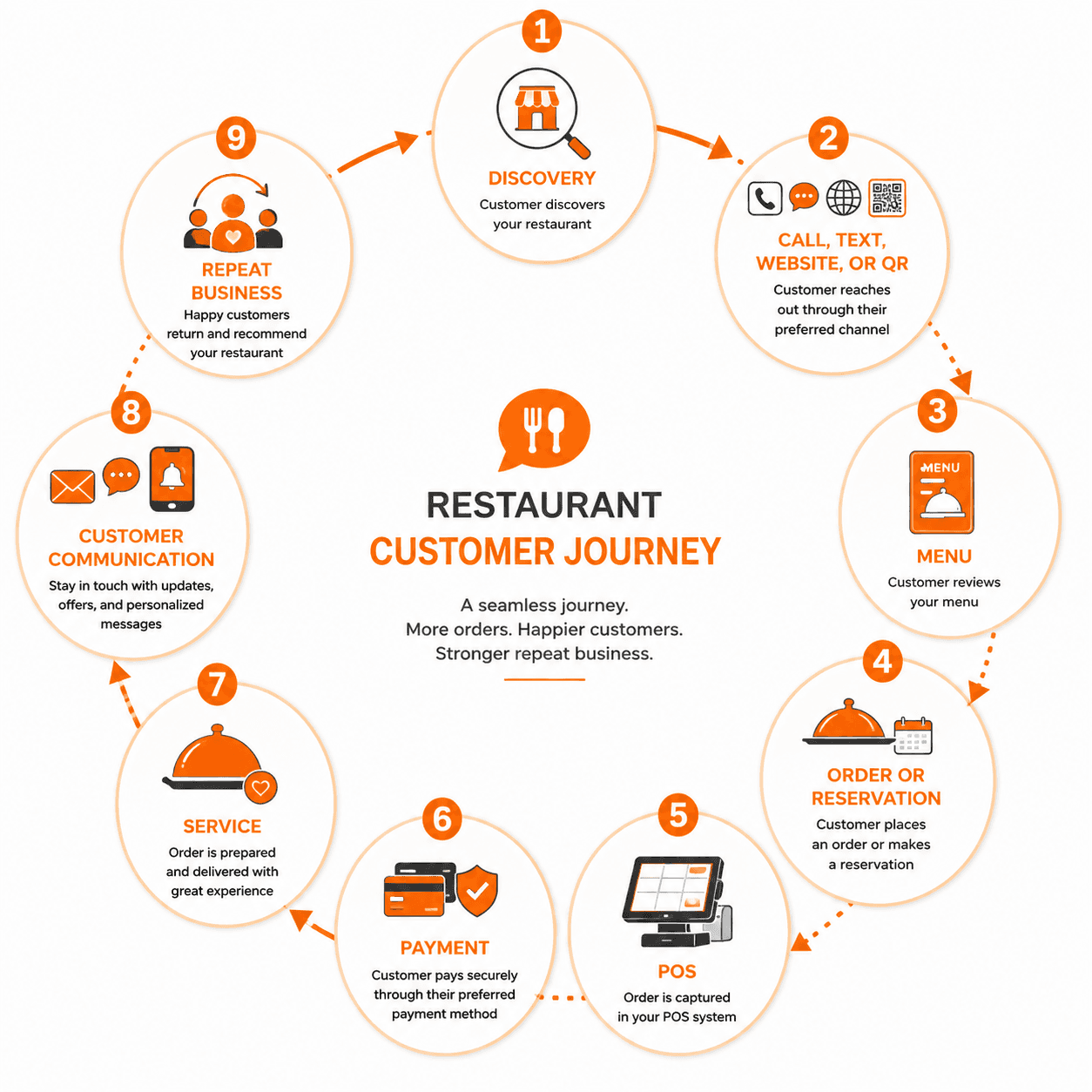
A problem anywhere in that journey can affect the merchant.
For example:
A strong POS does not help if phone orders are missed.
Fast payment processing does not fix a poor online ordering experience.
Multiple ordering channels become difficult if menu information is inconsistent.
Good technology does not create promotions when the owner has no time to market the restaurant.
This is why a restaurant technology partner should understand what happens before, during, and after the transaction.
Before recommending another product, ask:
How do customers order today?
What happens during the busiest hour?
How are calls handled?
Can customers order directly online?
How are reservations managed?
How many systems contain menu information?
Which workflows create the most pressure for staff?
These questions reveal more than a rate comparison ever will.
2. Stop competing only on rates, terminals, and hardware
Processing, terminals, hardware, and POS functionality remain important.
But when every merchant conversation begins with price, the partner gives the restaurant fewer reasons to see the relationship as strategic.
Compare these two conversations.
Traditional conversation | Better restaurant conversation |
|---|---|
What processing rate are you paying? | Where does your ordering process create friction? |
Do you need another terminal? | What happens when customers call during your busiest shift? |
Which POS features do you need? | Which restaurant workflows still require manual work? |
What hardware do you want? | Which customer channels need to work together? |
The second conversation starts with the restaurant.
That creates room to discuss outcomes such as:
Capturing more ordering opportunities
Reducing routine staff interruptions
Giving customers more direct ordering choices
Improving menu management
Making customer communication easier
Reducing unnecessary technology fragmentation
How can ISOs differentiate beyond payment processing?
ISOs can differentiate by combining payments expertise with restaurant-specific technology that addresses ordering, communication, digital commerce, menu management, and other operational needs.
Payments remain central.
The relationship simply becomes broader than processing alone.
The Restaurant Partner Value Stack
A useful way to think about the opportunity is through five layers.
Layer | What the partner helps the merchant do |
|---|---|
1. Payments | Accept and manage transactions |
2. Commerce | Give customers ways to order, reserve, and buy |
3. Operations | Connect restaurant ordering and service workflows |
4. Customer engagement | Communicate through phone, SMS, web, and other channels |
5. Growth | Support visibility, promotions, and repeat engagement |
A partner does not need to own every layer.
The framework simply helps identify where complementary technology can add value around the existing relationship.
The strongest opportunity is often not replacing the merchant's current technology. It is solving the gaps between the systems and workflows already in place.
3. Solve problems that happen before the transaction
Consider the restaurant phone during dinner rush.
Employees may already be serving guests, preparing food, coordinating pickups, and processing payments.
Then another customer calls.
That caller may want to:
Place an order
Ask a menu question
Make a reservation
Check restaurant information
Speak with staff
If the call cannot be handled, the interaction may never reach the POS or payment stage.
Restaurant Voice AI gives technology partners another way to address that problem.
SnapMenuAI VoiceAI can be configured to support restaurant phone interactions including ordering, menu questions, modifiers, reservation requests, multilingual conversations, payment-link workflows, confirmations, supported POS workflows, after-hours experiences, and human escalation.
Capabilities depend on restaurant configuration and supported integrations.
For a deeper look at the process, read AI phone ordering for restaurants.
The important partner question is not:
“Do you want Voice AI?”
It is:
“What happens when customers call and nobody on your team can reach the phone?”
4. Help merchants connect more customer channels
The restaurant experience increasingly extends beyond the physical POS.
Customers may want to:
Call
Text
Order online
Scan a QR code
Make a reservation
Pay digitally
Partners who understand these channels can help merchants create a more connected ordering strategy.
SMS ordering
SnapMenu SMS AI supports conversational restaurant interactions through text, including ordering, menu questions, modifiers, reservations, payment links, confirmations, and escalation when required.
Direct digital ordering
CommerceAI supports restaurant websites, direct online ordering, QR ordering, reservations, menus, and digital-commerce workflows.
Structured menu management
MenuBuilderAI helps turn restaurant menu information into structured digital data that can support connected ordering experiences.
The partner does not need to introduce all three.
Start with the customer or operational problem the restaurant actually has.
5. Stay valuable after installation
A restaurant technology relationship should not peak when the POS is installed or the merchant account becomes active.
Restaurant needs continue.
Marketing is a good example.
A restaurant may need to promote:
Seasonal items
Holidays
Specials
Events
New menu products
But an owner may not have time to continuously plan campaigns and create content.
PromoFlowAI supports restaurant marketing workflows around promotional planning, content creation, scheduling, and analytics.
Marketing-as-a-Service provides additional managed marketing support for restaurants that need hands-on execution.
For the partner, this creates another potential post-sale conversation.
But relevance comes first.
Do not introduce marketing because another product is available. Introduce it because the merchant has a marketing problem.
6. Build a pain-first cross-sell strategy
A strong cross-sell strategy should be simple:
Problem → Relevant solution → Demonstrated workflow → Confirmed fit
Do not present the entire product catalog in the first conversation.
Match the merchant need to the next conversation
Merchant need | Potential starting point |
|---|---|
Calls are difficult to manage | VoiceAI |
Customers want text ordering | SMS AI |
Direct ordering needs improvement | CommerceAI |
Menu digitization is difficult | MenuBuilderAI |
Marketing is inconsistent | PromoFlowAI |
Merchant needs hands-on marketing help | MAAS |
Start with discovery
Ask questions such as:
What happens when nobody can answer the phone during your busiest hour?
Can customers order directly from your website?
How are reservations managed?
What happens when someone calls after closing?
How many places need updating when the menu changes?
Can customers order through text?
Which technology task interrupts staff most often?
Who manages restaurant promotions?
Which systems currently work well and should stay?
What would you most like to simplify?
These questions help agents discover needs before discussing products.
For more partner-sales guidance, read the restaurant AI sales playbook for ISO agents and restaurant-focused AI solutions for ISOs.
7. Choose technology partners that complement your existing business
A good restaurant technology partnership should make the partner's current offering stronger, not unnecessarily compete with it.
Before adding a solution, evaluate:
Area | What to understand |
|---|---|
Restaurant fit | Which merchant problem does it solve? |
Technical fit | Which systems and integrations are required? |
Onboarding | Who configures and trains the merchant? |
Sales enablement | What demos and partner resources are available? |
Support | Who handles merchant and technical issues? |
Commercial model | Referral, reseller, bundled, integrated, or another structure? |
Merchant relationship | Who manages the merchant after the sale? |
Payments | How does it work with current processor and gateway relationships? |
Deployment | What technical or operational work is required? |
A technically strong product can still create a poor partnership if support, ownership, billing, or integration responsibilities are unclear.
Where SnapMenuAI fits into the partner strategy
SnapMenuAI is designed to complement the restaurant technology and merchant-services relationships that partners already have.
Potential partners include:
ISOs
ISVs
POS providers and resellers
Payment processors
Acquirers
Merchant-services providers
Restaurant technology companies
The SnapMenuAI ecosystem includes:
VoiceAI
Restaurant phone interactions, ordering, menu questions, reservations, multilingual conversations, payment support, confirmations, and escalation.
SMS AI
Conversational restaurant ordering and customer engagement through text.
CommerceAI
Restaurant websites, direct online ordering, QR ordering, reservations, menus, and digital-commerce workflows.
MenuBuilderAI
AI-assisted restaurant menu digitization and structured menu management.
PromoFlowAI
Restaurant promotional content, campaign workflows, scheduling, and analytics.
MAAS
Managed restaurant marketing support.
The objective is not to replace the partner's POS, processor, gateway, software, or merchant relationship.
It is to give restaurant technology partners additional problems they can help merchants solve when those needs appear.
The SnapMenuAI and ECS Payments partnership provides additional context on how restaurant technology and payment organizations can complement one another.
Become more valuable beyond the transaction
The payment transaction remains essential.
The POS remains essential.
But restaurant merchant problems do not begin and end at the terminal.
Customers call before they order.
Menus influence what they buy.
Websites and SMS create additional ordering paths.
Payments complete the transaction.
Marketing creates the next customer opportunity.
A great restaurant technology partner understands how those pieces connect and knows which problem to solve next.
That is how a partner moves from selling technology to helping restaurants build a better technology strategy.
Become a SnapMenuAI partner
If you already serve restaurant merchants, SnapMenuAI can help expand your technology offering across Voice AI, SMS ordering, digital commerce, menu management, and restaurant marketing while complementing existing POS and payment relationships.
Request a SnapMenuAI partner demo
Frequently asked questions
What is a restaurant technology partner?
A restaurant technology partner helps merchants evaluate, implement, integrate, or support technology used across POS, payments, ordering, menus, customer engagement, and restaurant operations. The partner may be an ISO, ISV, POS reseller, processor, acquirer, consultant, or technology provider.
How can ISOs differentiate beyond payment processing?
ISOs can combine payments expertise with restaurant-focused value-added technology around ordering, customer communication, digital commerce, menus, and other merchant needs. The objective is to complement the core payment relationship rather than replace it.
How can POS resellers add more value to restaurants?
POS resellers can look beyond hardware and software installation to identify problems around calls, ordering, reservations, menus, customer communication, and marketing. Complementary technology can then be introduced when it solves a specific merchant need.
Can restaurant AI work alongside an existing POS?
Yes, where supported integrations and configurations are available. Compatibility should be confirmed for the restaurant's specific POS, menu structure, payment environment, and operating workflow.
Does SnapMenuAI replace a restaurant's POS or processor?
No. SnapMenuAI is positioned as complementary restaurant technology. Deployment depends on the merchant's existing systems, payment relationships, configuration, and supported integrations.