
VP - Sales & Marketing


A practical framework to help ISO agents identify restaurant pain points, lead stronger merchant conversations, position AI around business value, and create new recurring revenue opportunities.
Restaurant merchants rarely ask their Independent Sales Organization, or ISO, for artificial intelligence.
They ask for help answering more calls, managing busy periods, reducing staff pressure, improving order accuracy, attracting customers, and creating more revenue.
That distinction matters.
The strongest restaurant AI sales conversation does not begin with technology. It begins with a business problem the merchant already recognizes.
For ISO agents, restaurant-focused AI creates an opportunity to move beyond rates, terminals, and processing agreements. It gives agents a more strategic conversation around customer demand, restaurant operations, merchant retention, and business growth.
This playbook explains how to lead that conversation.
Why restaurant AI matters to ISO agents

Restaurant-focused AI gives ISO agents a vertical-specific value-added solution that can complement an existing payment or point-of-sale relationship.
The opportunity is not simply to sell automation. It is to help restaurant merchants:
Answer more customer inquiries
Capture more phone and digital orders
Handle busy periods more consistently
Reduce interruptions for front-of-house staff
Improve customer communication
Maintain more consistent marketing
Create more connected ordering and payment workflows
For the ISO agent, this creates a stronger reason to contact an existing merchant or approach a new restaurant prospect.
Instead of opening with another rate comparison, the agent can begin with a recognizable operating problem.
Step 1: Identify the right restaurant opportunity
Not every restaurant will have the same needs or level of urgency.
The best prospects are restaurants where customer demand is already creating operational pressure.
Strong merchant signals
Look for restaurants that:
Receive a high volume of phone orders
Regularly place callers on hold
Have limited front-of-house staffing
Offer complex menus or many modifiers
Manage frequent pickup and delivery orders
Serve multilingual communities
Receive calls outside normal operating hours
Depend on reservations
Have inconsistent social media or email marketing
Operate multiple locations
Want to grow without adding unnecessary workload
These signals give the agent a business reason to start the conversation.
A better opening question
Avoid beginning with:
“Are you interested in AI?”
Use a question connected to daily restaurant operations:
“What normally happens when several customers call during your busiest hour?”
That question is easier for the merchant to answer because it reflects a real situation.
Step 2: Lead with merchant pain, not product features
Restaurant owners and managers usually care less about how the AI works than what business problem it helps solve.
Start with the cost of the current process.
Useful discovery questions include:
How many customer calls arrive during your busiest periods?
What happens when staff cannot answer immediately?
Who takes phone orders when the restaurant is busy?
How often do callers ask detailed menu questions?
Do you receive calls after closing or before opening?
How are complex modifiers confirmed?
Can customers complete payment after placing a phone order?
How consistently are promotions sent to customers?
How many systems do you use for ordering, marketing, menus, and payments?
What would improve if your team spent less time handling routine calls?
The goal is not to ask every question. Select the ones most relevant to the restaurant.
Step 3: Turn the problem into business value
Once the merchant explains the problem, connect it to a clear business outcome.
Merchant problem | ISO agent value conversation |
|---|---|
Calls go unanswered | Help the restaurant respond to more customer demand. |
Customers remain on hold | Give callers a faster path to menu information and ordering. |
Staff leave guests to answer calls | Support routine call handling so employees can focus on in-person service. |
Orders contain mistakes | Use menu-aware order confirmation and modifier handling. |
Calls arrive after hours | Give customers another way to place orders or receive assistance. |
Marketing is inconsistent | Support more regular promotional communication. |
Systems are disconnected | Connect ordering, menus, customer engagement, payments, and reporting where supported. |
The ISO conversation is focused only on price | Introduce a value-added solution tied to merchant growth. |
A strong ISO agent does not promise guaranteed results.
The agent explains how the workflow may help the merchant capture more opportunities and operate more consistently.
Step 4: Position VoiceAI as the lead solution
For many restaurant merchants, the phone is the clearest place to begin.
Missed calls, long hold times, menu questions, complex orders, and staff interruptions are easy for restaurant operators to recognize.
SnapMenuAI VoiceAI is designed to support restaurant phone ordering and customer assistance through capabilities such as:
24/7 call handling
Menu-aware responses
Phone order capture
Complex modifiers
Multilingual conversations
Reservation support
Payment links
SMS confirmations
Call transfer
After-hours ordering
Relevant upselling and cross-selling
POS and payment integrations where supported
The agent should not present all capabilities at once.
Connect the solution to what the merchant said during discovery.
Example
Merchant:
“We miss calls during Friday and Saturday dinner service.”
ISO agent:
“That is where VoiceAI may help. It is designed to handle customer calls, answer menu questions, take orders, and transfer exceptions while your team stays focused on the restaurant.”
This approach keeps the conversation relevant and avoids a generic feature presentation.
Step 5: Demonstrate the restaurant’s real workflow
A polished demonstration is useful, but a realistic demonstration is more persuasive.
Whenever possible, test the solution with:
The restaurant’s menu
Common modifiers
A temporarily unavailable item
A dietary question
A reservation request
A multilingual conversation
A payment-link step
A call transfer
A complex order
A request the AI should escalate
The National Institute of Standards and Technology identifies validity, reliability, safety, security and resilience, accountability, and transparency among the characteristics associated with trustworthy AI.[1]
For an ISO agent, this means the demonstration should show more than a perfect order. It should show how the system responds to uncertainty, exceptions, and real restaurant complexity.
Step 6: Build a simple business case
ISO agents should avoid invented savings estimates or unsupported revenue promises.
Instead, help the merchant evaluate observable operating factors.
Questions to quantify the opportunity
Ask the restaurant to review:
Number of calls received during peak periods
Number of calls missed or abandoned
Average phone-order value
Time employees spend handling routine calls
Number of after-hours inquiries
Frequency of order-entry mistakes
Number of locations
Current marketing workload
Existing monthly technology costs
The merchant can then compare its current process with the proposed workflow.
Example business case
A restaurant does not need a complicated return-on-investment model to understand the opportunity.
The conversation may be:
“If the restaurant receives more calls than the team can answer during peak hours, the first goal is to capture more of that existing demand. We can then review usage, order outcomes, and operational impact after implementation.”
This is more credible than promising a specific increase before the merchant has established a baseline.
Step 7: Handle common merchant objections
“My staff already answers the phone.”
Response:
VoiceAI is not intended to replace your team. It can support employees by handling routine calls, orders, and questions while transferring situations that need human attention.
“Our menu is too complicated.”
Response:
Complex menus are exactly why the evaluation matters. We should test your modifiers, combos, substitutions, availability, and common customer questions before deciding whether the solution fits.
“Customers want to speak with a person.”
Response:
Some will. The workflow should include clear call-transfer and escalation options. The goal is to handle routine demand while preserving human assistance when needed.
“We already have online ordering.”
Response:
Online ordering and phone ordering address different customer behaviors. VoiceAI can complement the existing digital channel by serving customers who prefer to call or need help with their order.
“I do not want another disconnected system.”
Response:
That is a valid concern. We should review supported POS and payment integrations, onboarding responsibilities, menu management, reporting, and support before moving forward.
“How is payment information handled?”
Response:
The full payment flow should be documented. Responsibilities depend on which systems store, process, or transmit payment information. The merchant and ISO should confirm the workflow with the relevant payment and technology parties.
The Payment Card Industry Data Security Standard establishes baseline requirements designed to protect payment account data.[2] Agents should never make broad compliance guarantees or assume that one vendor owns every responsibility.
Step 8: Expand the relationship after VoiceAI
VoiceAI can create the first restaurant growth conversation.
Once the merchant sees value, the ISO agent can explore related needs across the SnapMenuAI platform.
PromoFlowAI
For merchants that struggle to maintain consistent promotions, social content, SMS campaigns, or email marketing.
CommerceAI
For merchants that want connected online ordering, QR ordering, websites, reservations, menu management, payments, and reporting.
MenuBuilderAI
For merchants that need to convert or organize restaurant menus into structured digital formats.
Marketing-as-a-Service
For merchants that need hands-on support with content, local visibility, campaigns, and advertising management.
This expansion approach helps the agent build the relationship around the merchant’s next problem rather than forcing every product into the first conversation.
Step 9: Protect the ISO relationship
Before recommending a restaurant AI platform, the agent should understand:
Who owns onboarding
Who configures and updates menus
Which POS integrations are supported
Which payment workflows are supported
How calls are transferred
Who handles merchant support
How service interruptions are escalated
What reporting is available
How merchant billing works
How renewals and cancellations are managed
How referral or reseller revenue is calculated
Which responsibilities remain with the ISO
A restaurant AI partnership should strengthen the agent’s credibility, not create avoidable confusion after the sale.
The ISO agent talk track
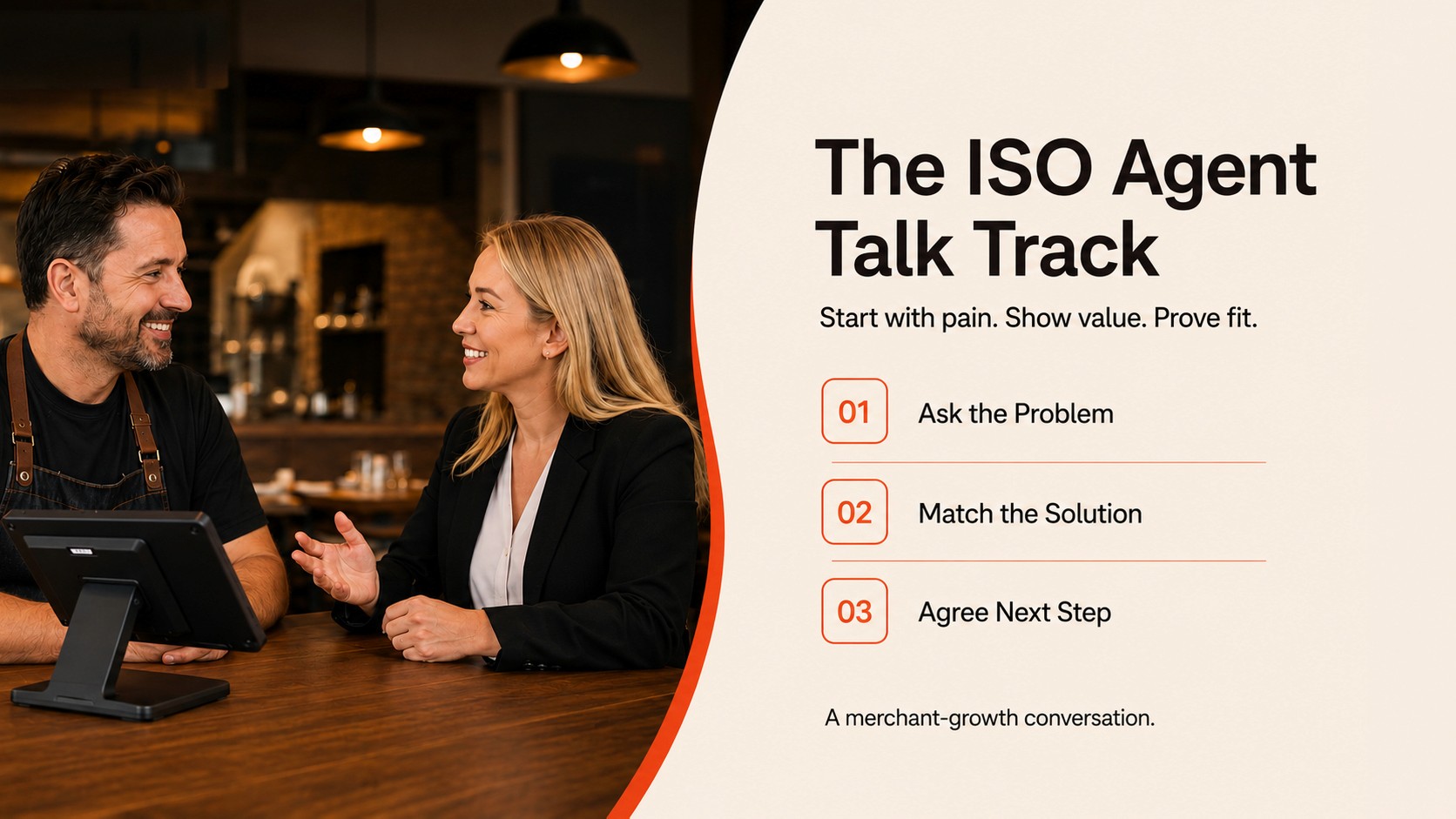
A simple sales conversation can follow this structure:
1. Open with the restaurant problem
“What happens to customer calls when the restaurant becomes busy?”
2. Explore the impact
“Do callers remain on hold, call back, or place the order somewhere else?”
3. Connect the problem to the solution
“We work with a restaurant-focused AI platform designed to handle calls, menu questions, orders, reservations, and payment links.”
4. Position the staff benefit
“The goal is to support your team during busy periods, not replace it.”
5. Propose a realistic demonstration
“Let us test it with your menu, common modifiers, and a few difficult customer requests.”
6. Agree on the next step
“If the workflow fits, we can review onboarding, integrations, support, and commercial terms.”
The executive takeaway
Restaurant-focused AI gives ISO agents a stronger way to create value beyond processing rates and terminals.
The most effective agents will not begin by selling AI. They will begin by understanding where the restaurant is losing time, customer attention, and revenue opportunities.
They will then connect the right solution to the right problem.
For ISO agents, the sales playbook is straightforward:
Identify the restaurant’s operating pressure
Ask practical discovery questions
Connect the pain to a business outcome
Lead with the most relevant workflow
Demonstrate real restaurant complexity
Build a credible business case
Address risks and responsibilities clearly
Expand the relationship over time
The best restaurant AI sale is not a technology pitch. It is a merchant-growth conversation.
Equip your agents with a stronger restaurant offer
SnapMenuAI helps ISO agents introduce restaurant-focused AI solutions for phone ordering, digital commerce, marketing, menu management, customer engagement, and restaurant operations.
Request an ISO partner demonstration to review the sales workflow, merchant use cases, onboarding, integrations, support model, and referral or reseller opportunities.
Visit SnapMenuAI to explore the partner opportunity.
Frequently asked questions
What is restaurant AI for ISO agents?
Restaurant AI refers to purpose-built technology designed around restaurant workflows such as phone ordering, menu questions, reservations, digital commerce, marketing, and payment-enabled customer interactions.
Which SnapMenuAI solution should an ISO agent lead with?
VoiceAI is often the clearest starting point because missed calls, phone orders, menu questions, and busy-period staff pressure are easy for restaurant merchants to recognize.
Should ISO agents sell restaurant AI as a labor replacement?
No. Position it as a support tool that handles routine demand and allows restaurant employees to focus on in-person guests, exceptions, and higher-value work.
What should agents ask during discovery?
Ask what happens to calls during busy periods, who handles phone orders, how complex modifiers are confirmed, whether calls arrive after hours, and which customer or marketing tasks create the most pressure.
How should an agent demonstrate restaurant AI?
Use a realistic menu and test complex modifiers, unavailable items, dietary questions, multilingual requests, reservations, payment links, call transfers, and integration interruptions.
How can restaurant AI create revenue for an ISO?
Depending on the partnership structure, an ISO may earn referral fees, reseller margins, recurring revenue sharing, or revenue from bundled value-added services.
What should agents avoid promising?
Avoid guaranteed revenue, exact savings, universal compatibility, effortless implementation, full compliance, or specific deployment timelines without evidence and technical discovery.
Disclosure and disclaimer
SnapMenuAI has a commercial interest in the subject of this article.
This article provides general information and is not legal, security, compliance, tax, or financial advice. Requirements may vary by state, processor relationship, sponsor bank, card network, vendor agreement, business model, and contractual arrangement. Consult qualified advisers and current official guidance.