
Senior Vice President of Sales


Artificial intelligence is becoming part of nearly every conversation across payments, point-of-sale technology, banking, merchant services, and restaurant operations.
For Independent Sales Organizations, or ISOs, the opportunity is not simply to add another AI product to the portfolio. It is to introduce technology that solves a real merchant problem, operates reliably, and creates value beyond payment rates and terminals.
An ISO is a third-party sales organization that markets merchant services through relationships with acquiring banks, payment processors, or other payment providers. ISOs are subject to certain restrictions under these relationships. Depending on its agreements, an ISO may also support merchant onboarding, equipment deployment, account management, and ongoing merchant service.
For ISOs serving restaurant merchants, purpose-built AI can create a stronger commercial conversation. It can help restaurants respond to more customers, capture more orders and reservations, do so more accurately, support staff during busy periods, and build more dependable customer interactions.
The best AI opportunity for ISOs is not automation alone. It is helping merchants capture demand and grow.
Why should ISOs consider restaurant-focused AI solutions?
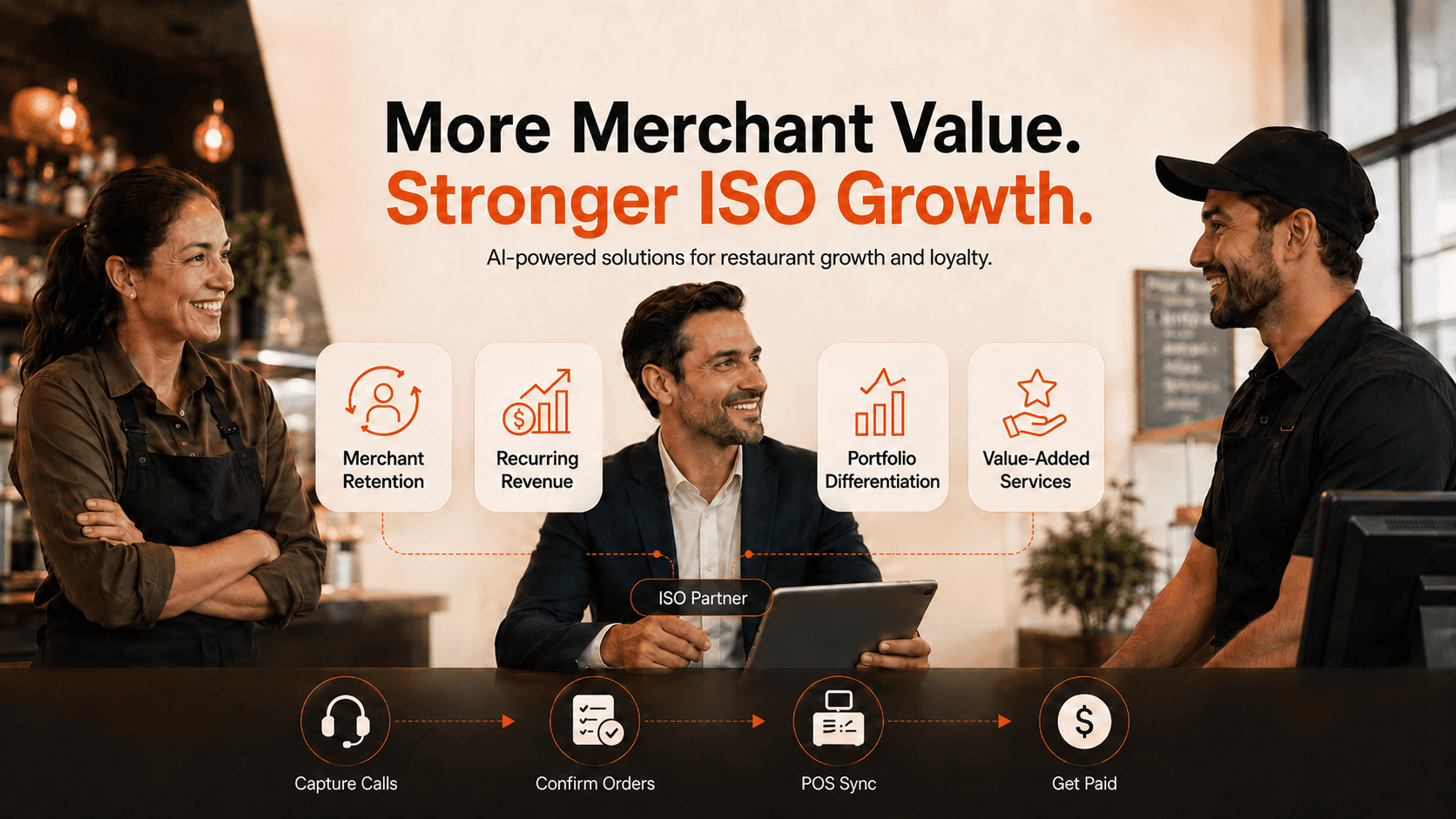
ISOs should consider restaurant-focused AI solutions because they can create value for both the merchant and the ISO.
For the restaurant, the value may include:
More calls answered
More orders captured
Better handling of menu questions
Support during busy periods
Improved customer access
More consistent order confirmation
After-hours call coverage
For the ISO, the value may include:
Stronger agent conversations
Better portfolio differentiation
Greater merchant retention
New recurring revenue opportunities
More value beyond rates and terminals
Deeper relationships with restaurant merchants
The opportunity becomes more meaningful when the solution complements the ISO’s existing payment and POS relationships instead of trying to replace them.
Not every AI solution fits restaurant operations
AI applications are not created equal.
Some solutions are designed around a specific industry and workflow. Others use a broad technology approach across many unrelated business needs.
A general AI platform may be able to hold a conversation, answer a basic question, or summarize information. Restaurant operations require a deeper level of context.
A restaurant-focused AI solution may need to understand:
Menu categories
Item sizes
Modifiers
Combos
Substitutions
Limited-time items
Unavailable ingredients
Allergens
Dietary questions
Pickup orders
Reservations
Multilingual customers
Payment links
POS workflows
Call transfers
Rush-hour demand
A customer may ask to remove one ingredient, add another, split toppings across a pizza, change a side, ask about an allergen, confirm preparation time, and pay through a link.
The value of the technology depends on whether it can handle those details accurately and consistently.
The National Institute of Standards and Technology identifies validity, reliability, safety, security, resilience, accountability, and transparency as important characteristics of trustworthy AI.
For an ISO, the practical lesson is simple: a strong demonstration is not enough. The solution must perform reliably in real restaurant environments.
Source: National Institute of Standards and Technology, Artificial Intelligence Risk Management Framework 1.0
Reliability protects the ISO relationship
An ISO’s reputation is built through merchant trust.
Even when the ISO does not own the technology, the merchant may still associate the solution with the agent or organization that introduced it.
That makes reliability a business issue, not only a technical issue.
Before introducing a restaurant-focused AI solution, an ISO should understand:
Who owns merchant onboarding?
Who manages menu updates?
How are unavailable items handled?
How are modifiers confirmed?
What happens when a POS connection is unavailable?
When is a call transferred to restaurant staff?
Who owns technical support?
Who manages the payment workflow?
Which systems store, process, or transmit payment data?
How are service issues escalated?
The Payment Card Industry Data Security Standard, or PCI DSS, establishes technical and operational requirements designed to protect payment account data.
The exact responsibilities depend on the payment flow and on which systems and organizations store, process, or transmit payment information.
ISOs should confirm responsibilities with the processor, gateway, acquiring institution, sponsor bank, technology provider, merchant, and qualified advisers.
Source: PCI Security Standards Council, PCI DSS document library
Efficiency matters, but growth creates a stronger conversation
Many restaurant technology solutions begin with an efficiency message.
A tool may help with:
Tip management
Accounting updates
Reporting
Reconciliation
Administrative tasks
Staff productivity
Those benefits are useful.
However, helping a restaurant capture more customer demand creates a more powerful merchant relationship.
There is an important difference between saying:
“Here is another tool that can reduce administrative work.”
and saying:
“Here is a solution designed to help your restaurant respond to more customers and capture more orders.”
In my experience, restaurant owners value partners who understand how their business makes and loses money.
When an ISO agent can discuss missed calls, long hold times, inaccurate orders, after-hours demand, and customer frustration, the conversation moves beyond processing rates.
The ISO becomes a business partner, not only a provider of payment services.
Where restaurants lose phone-order opportunities
Phone calls remain important when customers want to:
Place a takeout order
Ask about menu items
Request a substitution
Confirm availability
Make a reservation
Ask about pickup time
Speak with the restaurant
Get help with a complex order
The problem is that calls often arrive when the restaurant is busiest.
Staff may already be serving guests, coordinating with the kitchen, handling pickup orders, managing delivery drivers, and processing payments.
Three common problems appear during these periods.
Limited order-taking capacity
A restaurant may have limited phone capacity and only a few employees available to answer calls.
A complex order can keep one employee on the phone while other customers wait.
Staff may also leave tables or the host stand to answer routine questions.
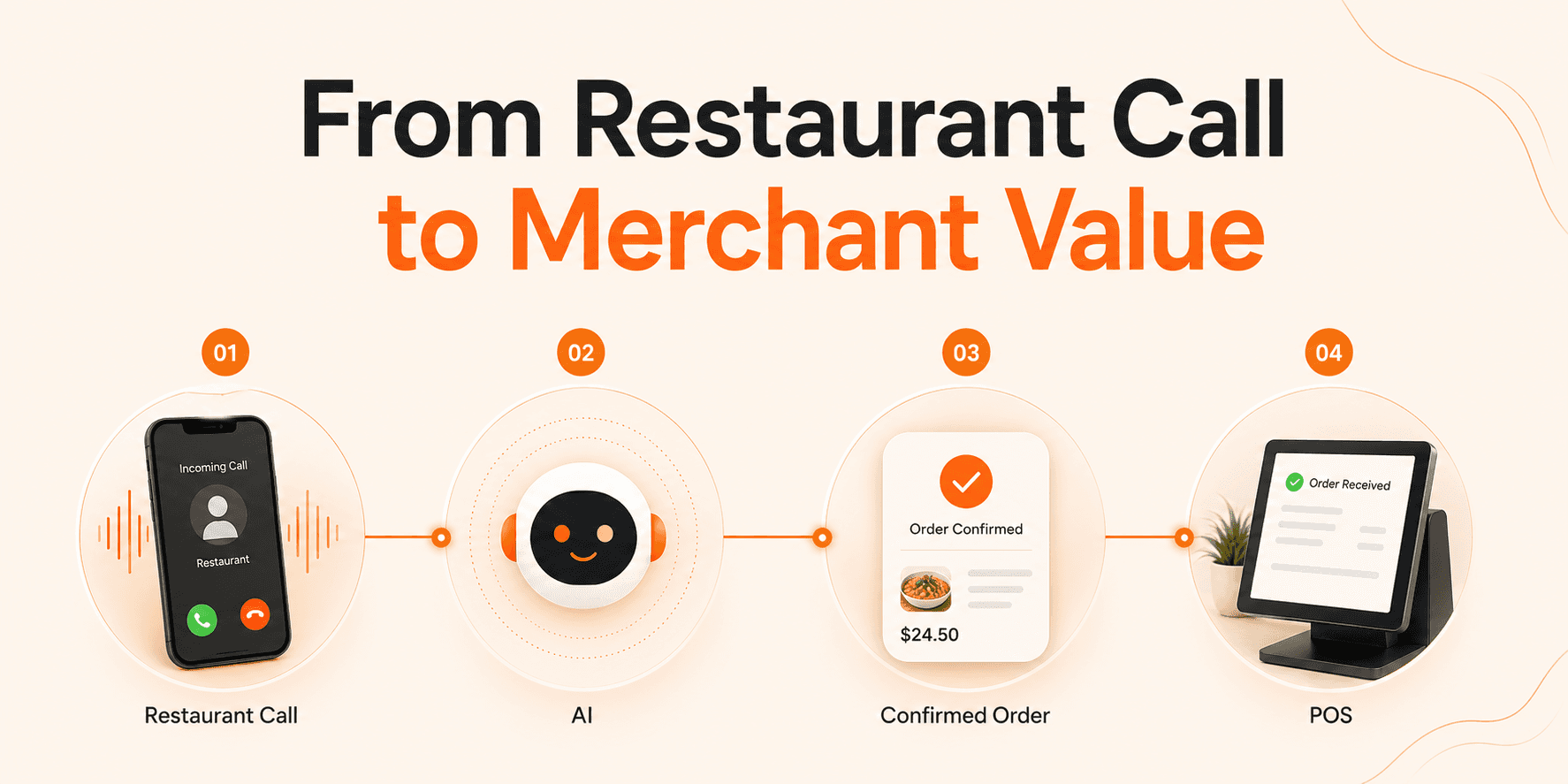
A restaurant-focused AI solution can support employees by handling routine calls and allowing staff to focus on in-person guests and exceptions.
Inaccurate or incomplete orders
Restaurant orders may include sizes, toppings, modifiers, substitutions, preparation requests, combo options, and dietary questions.
A useful AI solution should use approved menu information, confirm each item, repeat modifiers, and transfer requests it cannot handle confidently.
Order accuracy matters because incorrect orders can affect:
Food costs
Staff time
Refunds
Customer satisfaction
Repeat business
Merchant trust
Dropped and unanswered calls
Customers may abandon a call when they receive a busy signal, remain on hold too long, or cannot reach the restaurant after hours.
Some customers will try again. Others may call another restaurant.
Helping a restaurant respond more consistently gives the ISO a value story connected to customer experience, order capture, and merchant growth.
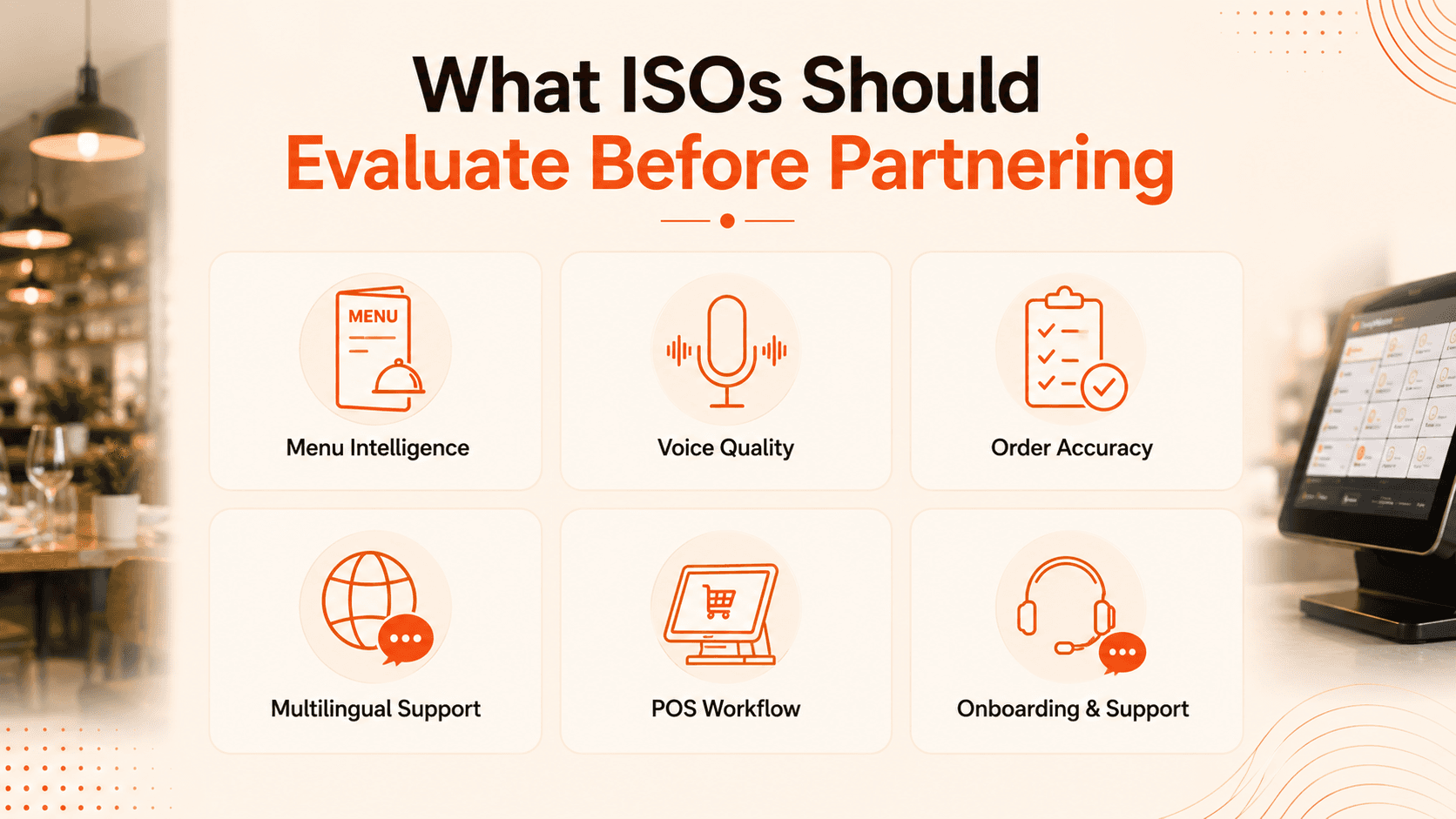
What should ISOs evaluate?
ISOs should evaluate restaurant-focused AI through both a merchant-value lens and a partner-risk lens.
Evaluation area | Why it matters |
Restaurant-specific intelligence | The platform should understand menus, modifiers, combos, availability, and restaurant terminology. |
Voice quality | Customer conversations should sound clear and natural. |
Order accuracy | Items, sizes, quantities, and modifiers should be confirmed correctly. |
Concurrent-call capacity | The platform should support demand during busy periods. |
Multilingual support | Supported languages should match the merchant’s customer base. |
Call transfer | Complex or sensitive requests should reach restaurant staff. |
POS integration | Orders should fit the merchant’s existing workflow where supported. |
Payment workflow | Payment links and payment responsibilities should be documented clearly. |
Reporting | Merchants should be able to review calls, orders, outcomes, and exceptions. |
Onboarding and support | The provider should clearly own setup, training, and issue resolution. |
Multi-location support | The platform should support different menus, hours, and locations. |
Partner economics | Referral, reseller, billing, renewal, and support terms should be clear. |
ISOs should not evaluate a platform using only a simple order demonstration.
Ask the provider to handle:
A complex modifier
An unavailable item
A dietary question
A multilingual request
A reservation
A payment-link step
A call transfer
A simulated POS interruption
How the platform handles exceptions may matter more than how it handles a perfect order.
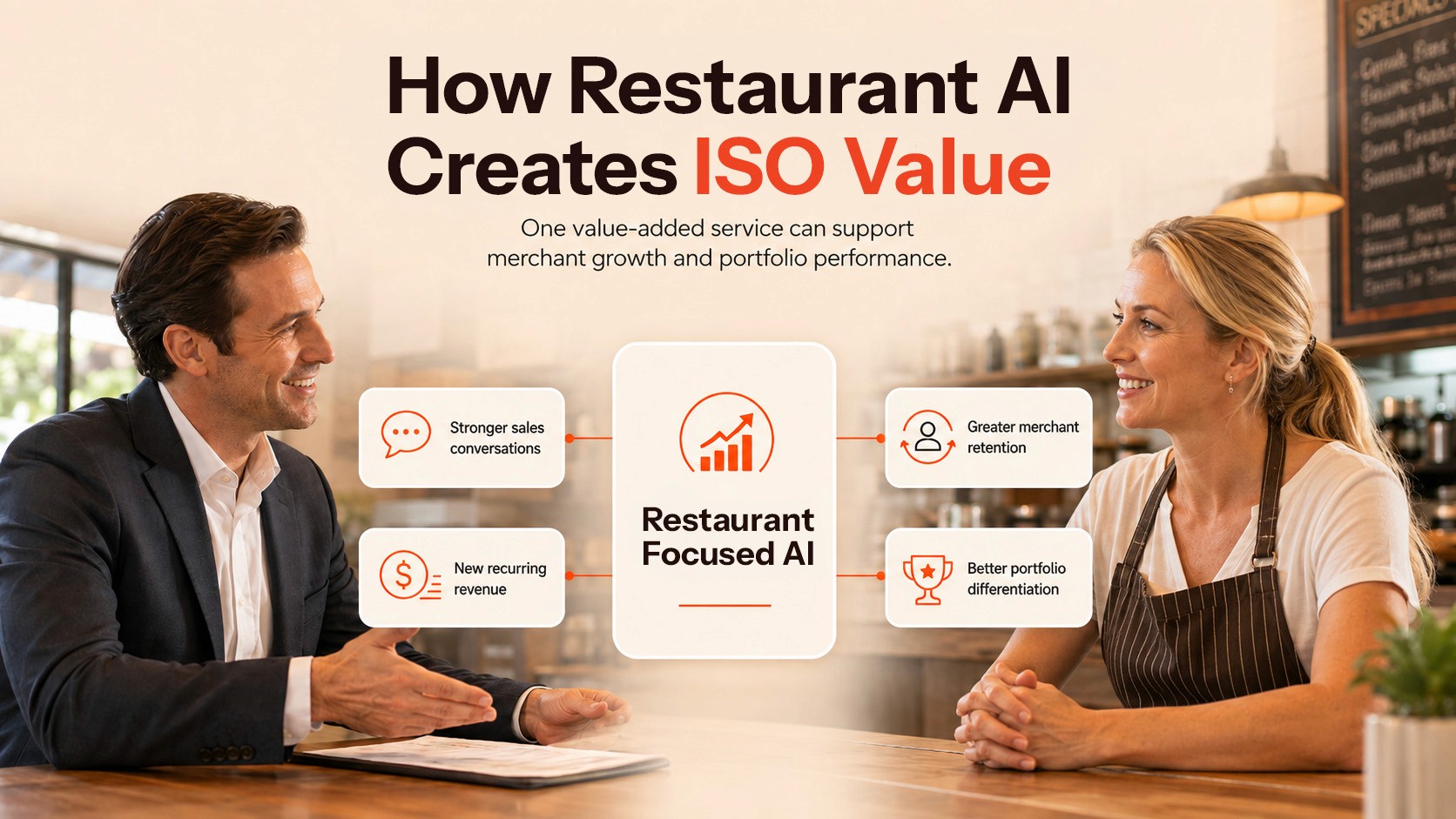
How restaurant-focused AI creates ISO value
Stronger merchant conversations
Agents gain a restaurant-specific growth story instead of relying only on rates, terminals, and processing contracts.
Better differentiation
A restaurant-focused solution helps the ISO stand apart from providers offering only payment processing.
Greater merchant retention
A solution connected to customer calls, orders, reservations, and restaurant operations can make the ISO more valuable to the merchant.
New recurring revenue
Depending on the partner agreement, ISOs may participate through referral fees, reseller margins, revenue sharing, or bundled value-added services.
Expanded portfolio relationships
ISOs can introduce the solution to restaurant merchants already using their payment, gateway, terminal, or POS relationships.
More customer demand captured
The solution can help restaurants respond to calls and inquiries that might otherwise go unanswered.
How SnapMenuAI fits the opportunity
SnapMenuAI is a restaurant-focused AI platform designed around customer calls, ordering, menu questions, reservations, payment workflows, and restaurant operations.
Based on approved product information, SnapMenuAI is designed to support capabilities such as:
AI voice ordering
24/7 call handling
Menu-aware customer responses
Complex orders and modifiers
Multilingual conversations
Reservation handling
Payment links
SMS confirmations
POS integrations
Payment integrations
Call transfer
After-hours order capture
Relevant upselling and cross-selling
Customer question handling
For ISOs, SnapMenuAI creates a restaurant-focused merchant conversation centered on order capture, customer engagement, and operational support.
It can complement existing payment and POS offerings where the required integrations are supported.
Before presenting the platform to merchants, ISOs should confirm current integrations, languages, onboarding responsibilities, payment workflows, support ownership, reporting, partner terms, and multi-location capabilities.
Executive takeaway
ISOs should not introduce AI simply because the market is talking about it.
They should choose solutions that understand the merchant’s business, operate reliably, create observable value, and strengthen the merchant relationship.
Restaurant-focused AI solutions can help restaurants reduce friction to the order by responding to more customers, supporting staff during busy periods, improving order handling, and creating a clearer path from conversation to order, reservation, or payment.
For the ISO, that can create:
Stronger agent conversations
Better differentiation
More value for restaurant merchants
Deeper merchant relationships
Greater portfolio retention
New recurring revenue opportunities
Explore the SnapMenuAI partner opportunity
ISOs, ISVs, agents, and payment companies can request a partner demonstration to see how restaurant-focused AI solutions may fit their merchant portfolios.
The conversation can also cover referral, reseller, payment, POS, and integration opportunities.
Frequently asked questions
What is a restaurant-focused AI solution?
A restaurant-focused AI solution is technology designed around restaurant-specific workflows such as phone ordering, menu questions, modifiers, reservations, payment links, and customer support.
How can restaurant-focused AI help an ISO?
It can give agents a stronger sales conversation, help merchants capture more customer demand, support merchant retention, and create new recurring revenue opportunities.
Does restaurant-focused AI replace restaurant employees?
No. It should be positioned as a support tool that handles routine calls and requests while transferring complex or sensitive situations to restaurant staff.
What should an ISO test during a demonstration?
The ISO should test modifiers, unavailable items, dietary questions, multilingual requests, reservations, payment links, call transfers, and POS interruptions.
How should an ISO evaluate payment responsibilities?
The ISO should map the full payment workflow and identify which party stores, processes, or transmits payment information. Responsibilities should be confirmed with the relevant processor, gateway, acquiring institution, sponsor bank, vendor, merchant, and qualified advisers.
Can restaurant-focused AI support different restaurant sizes?
A capable platform may support independent restaurants, franchise groups, multi-location operators, quick-service restaurants, full-service restaurants, cafes, and larger restaurant organizations. The ISO should confirm integrations, support, reporting, and location-management capabilities.
How can an ISO generate revenue from a restaurant AI partnership?
Possible models include referral fees, reseller margins, recurring revenue sharing, integration partnerships, or bundled value-added services. The commercial agreement should clearly define pricing, billing, renewals, cancellations, support, and account ownership.
Disclosure and disclaimer
SnapMenuAI has a commercial interest in the subject of this article.
This article provides general information and is not legal, security, compliance, tax, payroll, or financial advice. Requirements may vary by state, locality, processor, gateway, acquiring institution, sponsor bank, card network, vendor, business model, and contractual arrangement. Consult qualified advisers and current official guidance.