
VP - Sales & Marketing


Winning a new restaurant merchant creates revenue. Retaining that merchant creates the relationship.
A restaurant may initially choose a reseller for its POS, payments, or commercial terms. But the reasons it continues working with that partner are often different: useful technology guidance, responsive support, and help solving new problems as the restaurant grows.
For POS resellers, ISOs, ISVs, and payment companies, that creates an opportunity to remain valuable beyond the original sale.
SnapMenuAI helps partners expand restaurant merchant relationships with complementary solutions for customer calls, ordering, digital commerce, menu management, and marketing without requiring the merchant to replace technology that already works.
The goal is not to sell every product.
It is to solve more of the restaurant's real problems while strengthening the merchant relationship you already have.
Why merchant retention requires continued value
A POS or payment solution may solve the merchant's original need, but restaurant operations continue to create new challenges.
The merchant may still struggle with:
Calls during rush hours
After-hours customer inquiries
Direct online ordering
Text-based ordering
Menu updates
Staff interruptions
Customer communication
Restaurant promotions
A reseller that understands these problems has more reasons to continue meaningful merchant conversations after go-live.
Merchant retention depends on many factors, including product performance, service, commercial terms, support, and competition. No additional technology guarantees retention.
But continued relevance can make the partner relationship more valuable to the restaurant over time.
Look beyond the POS transaction
A restaurant customer interacts with much more than the POS.
The journey may look like:
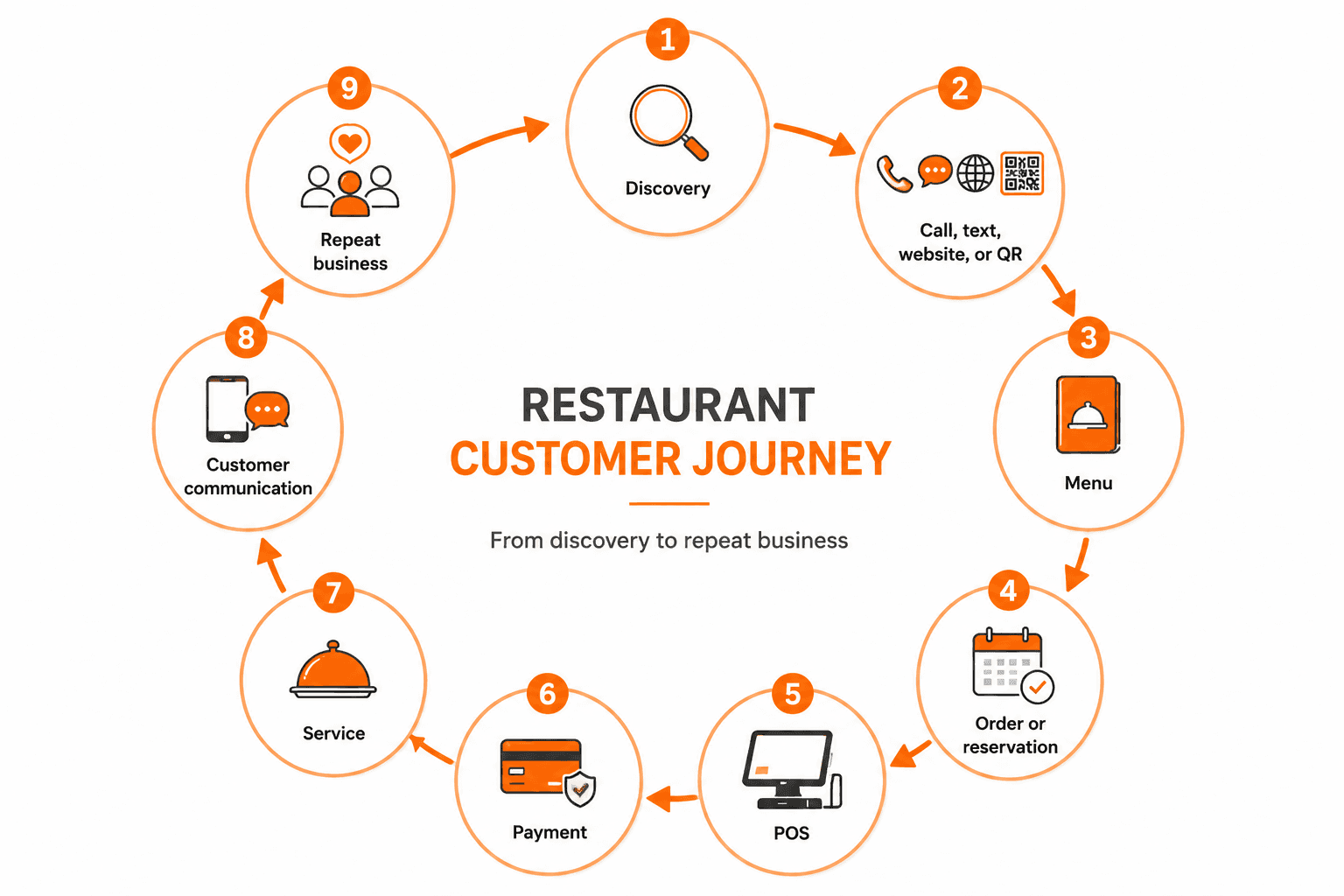
The POS and payment transaction remain critical, but they are only part of the customer experience.
That changes the conversation for restaurant technology partners.
Traditional POS conversation | Broader merchant conversation |
|---|---|
Processing rate | Where customer opportunities are being lost |
Payment terminal | How customers reach and order from the restaurant |
POS features | How ordering workflows connect |
Hardware | Which customer channels need support |
Transaction processing | Voice, SMS, online, QR, and in-store ordering |
Initial installation | Ongoing merchant value |
The reseller does not need to own every part of the restaurant technology stack.
The opportunity is to understand where the merchant is experiencing friction and where complementary technology can help.
How SnapMenuAI helps partners stay relevant
SnapMenuAI gives restaurant technology partners a broader set of capabilities they can introduce when the merchant has a specific need.
Restaurant need | SnapMenuAI solution |
|---|---|
Calls are difficult to manage | VoiceAI |
Customers want conversational text ordering | SMS AI |
Direct web and QR ordering needs improvement | CommerceAI |
Menu digitization or management is difficult | MenuBuilderAI |
Restaurant promotions are inconsistent | PromoFlowAI |
Merchant needs hands-on marketing support | MAAS |
This is not a bundle that every restaurant needs.
It is a problem-to-solution framework.
A partner should start with the merchant's most important challenge, demonstrate the relevant workflow, and expand only when another need becomes clear.
Help restaurants manage phone demand
During a busy restaurant shift, employees may already be serving guests, preparing food, managing pickups, and processing payments.
The phone still rings.
A caller may want to place an order, ask a menu question, make a reservation, or get restaurant information.
SnapMenuAI VoiceAI can be configured to support restaurant phone interactions such as:
24/7 call handling
Pickup and delivery ordering
Menu questions
Modifiers and customizations
Reservation requests
Multilingual conversations
Payment-link workflows
SMS confirmations
Supported POS workflows
Human transfer and escalation
Capabilities depend on the restaurant's configuration and supported integrations.
For the partner, the better conversation is not:
“Do you want Voice AI?”
It is:
“What happens to customer calls when your team is too busy to answer?”
Learn more about AI phone ordering for restaurants.
Give customers more direct ordering choices
Some restaurant customers prefer calling. Others prefer texting or ordering online.
That creates opportunities to improve direct customer access without changing the restaurant's core POS relationship.
SnapMenu SMS AI supports conversational ordering through text, including menu questions, modifiers, reservations, payment links, confirmations, and escalation where required.
CommerceAI supports restaurant websites, direct online ordering, QR ordering, reservations, menus, and digital-commerce workflows.
For the merchant, the benefit is more ways for customers to interact and order directly.
For the partner, it creates another useful conversation around the existing technology relationship.
Make menu management easier
The same restaurant menu may need to work across:
POS
Voice ordering
SMS ordering
Website ordering
QR ordering
That makes structured menu information increasingly important.
MenuBuilderAI helps restaurants organize menu information for connected digital ordering experiences.
For partners, menu management can become part of a better merchant onboarding and ordering strategy instead of simply being treated as a one-time upload.
Continue helping after go-live
Restaurant needs continue after POS installation and payment activation.
Marketing is one example.
Restaurants regularly need to promote specials, seasonal items, holidays, events, and new menu products, but owners may have limited time to create and manage campaigns consistently.
PromoFlowAI supports restaurant promotional planning, content creation, scheduling workflows, and analytics.
For restaurants that need additional execution support, Marketing-as-a-Service provides a managed marketing option.
The rule remains the same:
Introduce the capability because the merchant has the problem, not because another product is available.
What POS resellers and payment partners gain
The value of the SnapMenuAI partnership is not simply a larger product catalog.
It is more relevant merchant conversations.
Partner benefit | What it means |
|---|---|
Differentiate beyond rates and terminals | Add restaurant-specific technology to the merchant conversation |
Stay engaged after go-live | Continue solving problems as restaurant needs change |
Strengthen merchant relationships | Bring additional operational value to the account |
Create cross-sell opportunities | Match identified merchant needs with complementary capabilities |
Expand the restaurant offering | Add customer engagement, ordering, commerce, menu, and marketing solutions |
Support recurring-revenue opportunities | Depending on the specific partnership agreement |
Give agents better sales conversations | Lead with restaurant problems instead of price alone |
Protect the existing relationship | Complement POS and payment environments rather than replace them |
For ISOs and payment partners, this means the merchant relationship can extend beyond processing.
For POS resellers, it means the conversation can continue beyond hardware and software installation.
For ISVs, it can create opportunities to add restaurant-specific capabilities without building every function internally.
What restaurant merchants gain
The restaurant also needs a clear business reason to adopt additional technology.
Restaurant challenge | Potential benefit |
|---|---|
Busy phone lines | More consistent call handling |
Customers want more ordering choices | Voice, text, web, and QR options |
Routine staff interruptions | More repeatable interactions can be automated |
Weak direct ordering experience | More direct digital-commerce options |
Difficult menu management | Better structured menu information |
Customer communication | Conversational and confirmation workflows |
Marketing workload | AI-assisted or managed marketing support |
Not every restaurant needs every capability.
The strongest recommendation is the one tied to the restaurant's current operating problem.
Use a retention-focused partner strategy
A simple partner motion keeps the relationship consultative:

Discover the merchant's next problem
After the core POS or payment relationship is established, ask questions such as:
What happens when nobody can answer the restaurant phone?
Can customers order directly from your website?
Can customers place an order through text?
How difficult is it to update menu information?
Which customer interactions take the most staff time?
Who manages restaurant promotions?
Which parts of your current technology setup work well and should remain unchanged?
That final question is important.
A good partner should understand what not to replace.
Solve one problem first
If phone demand is the problem, focus on the phone workflow.
If direct ordering is weak, focus on digital commerce.
If menu management is slowing the restaurant down, focus there.
The first conversation does not need to include every SnapMenuAI capability.
Demonstrate the restaurant workflow
Show how the technology fits the merchant's actual operation.
For example:
Customer calls → Order captured → Details confirmed → Supported POS or payment workflow

or:
Customer texts → Menu conversation → Customization → Payment link → Confirmation
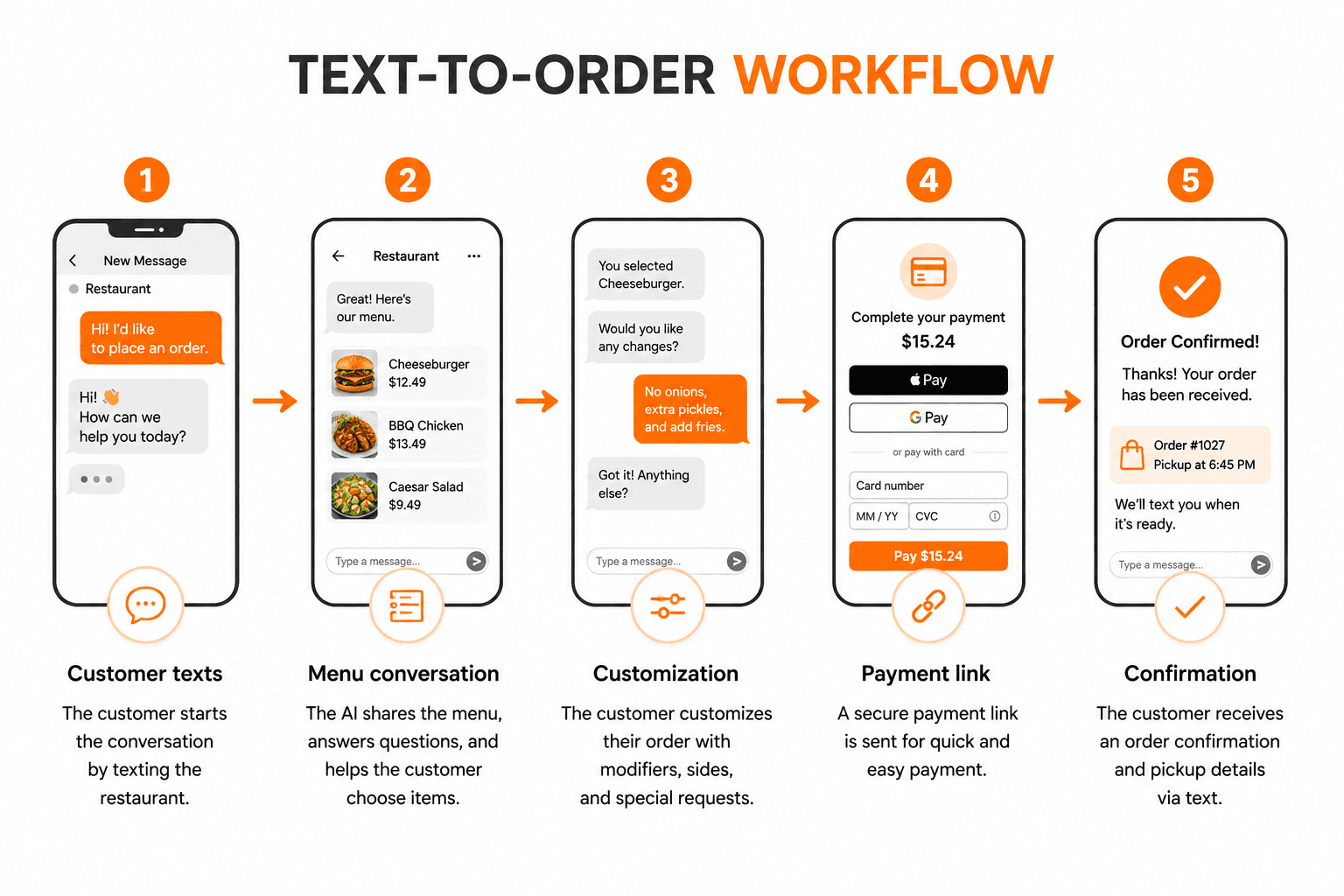
A clear workflow is easier for the restaurant owner to evaluate than a long feature list.
Expand when another need becomes clear
Once one problem has been addressed, continue discovery.
If another legitimate need appears later, introduce the next relevant capability.
That creates a healthier cross-sell strategy than repeatedly pushing new products into the account.
SnapMenuAI complements the partner relationship
SnapMenuAI is designed for organizations that already serve restaurant merchants, including:
POS providers and resellers
ISOs
ISVs
Payment processors
Acquirers
Merchant-services providers
Restaurant technology companies
SnapMenuAI is not positioned to replace the partner's POS, processor, gateway, software platform, or merchant relationship.
The opportunity is to add restaurant-focused capabilities around those existing relationships.
That can help partners address more restaurant problems without having to build every Voice AI, ordering, commerce, menu, or marketing capability internally.
The SnapMenuAI and ECS Payments partnership provides additional context on how payment organizations and restaurant technology can complement one another.
Retention comes from staying relevant
A POS reseller or payment partner should not need to wait for a terminal replacement or contract renewal to have another valuable conversation with a restaurant merchant.
Restaurant needs continue to change.
Calls still need to be handled.
Customers need convenient ways to order.
Menus need to remain accurate.
Digital ordering needs to work.
Marketing still requires attention.
The original POS or payment relationship opens the account. Continued usefulness gives the merchant more reasons to keep that relationship valuable.
SnapMenuAI helps restaurant technology partners extend that value with complementary restaurant AI, ordering, commerce, menu, and marketing capabilities.
Add more value to your restaurant merchant portfolio
If you already serve restaurant merchants, SnapMenuAI can help expand your technology offering while complementing the POS and payment relationships you already have.
Request a SnapMenuAI partner demo
Frequently asked questions
How can SnapMenuAI help POS resellers strengthen merchant relationships?
SnapMenuAI gives POS resellers additional restaurant-focused capabilities around customer calls, SMS ordering, digital commerce, menu management, and marketing. Partners can introduce these capabilities when merchants have relevant operational needs while keeping the existing POS relationship in place.
How can SnapMenuAI support restaurant merchant retention?
SnapMenuAI can help partners remain useful after the original POS or payment sale by giving them additional restaurant problems to solve. Merchant retention depends on many factors, so SnapMenuAI should be positioned as a way to add ongoing merchant value rather than as a guaranteed retention solution.
What are the benefits for ISOs and payment partners?
ISOs and payment partners can use SnapMenuAI to differentiate beyond processing rates and terminals, create additional merchant conversations, expand restaurant technology offerings, support cross-selling, and explore recurring-revenue opportunities depending on the partnership agreement.
What are the benefits for restaurant merchants?
Restaurant merchants can gain additional capabilities around phone calls, direct ordering, SMS ordering, digital commerce, menu management, customer communication, and marketing while continuing to use supported existing POS and payment environments.
Does SnapMenuAI replace the restaurant's POS or payment processor?
No. SnapMenuAI is positioned as complementary restaurant technology. Deployment depends on the merchant's existing systems, payment setup, configuration, and supported integrations.
Should partners offer every SnapMenuAI solution to every restaurant?
No. Partners should begin with the restaurant's most important operational problem and introduce the solution that best fits that need. Additional capabilities should be introduced only when another clear merchant requirement appears.