
Co-Founder & CTO, SnapMenuAI, Inc


Running a restaurant in 2026 is not easy to handle.
Your team may already be serving dine-in guests, preparing pickup orders, watching online orders, helping delivery drivers, taking payments, and keeping the kitchen moving.
Then the phone rings.
For a restaurant owner, that call matters because the person on the other end may already be ready to order. They may want to check a menu item, ask about ingredients, find a vegetarian or vegan option, make a reservation, or confirm something before placing an order.
The problem is that your staff cannot always stop what they are doing every time the phone rings.
And when nobody answers, it may be more than a missed call. It may be a missed order opportunity.
This is where Voice AI for restaurants can help. An AI phone ordering assistant can answer customer calls, take orders, understand menu questions and customizations, guide customers through available choices, support reservations, and involve staff when human help is needed.
The goal is simple: make it easier to serve customers on the phone without putting more pressure on the team already serving the restaurant.
Why restaurant phone calls still matter

Customers have more ways to order today, but the phone is still important for people who want a quick answer or prefer talking before they buy.
A caller may want to:
Place a pickup or delivery order
Ask whether an item is available
Check what comes with a meal
Change an ingredient or side
Ask about vegetarian or vegan choices
Check ingredient or allergen information
Make a reservation
Confirm restaurant hours
Many of these calls happen close to the buying decision.
The customer may already know where they want to order. They simply need one final answer.
That is why unanswered calls should not be treated only as a customer-service issue.
Some missed calls may also mean missed order opportunities.
What is Voice AI for restaurants?
Voice AI for restaurants is a voice-based system designed to handle restaurant customer conversations over the phone.
Instead of playing a recorded message or asking customers to press numbers, the system can listen to what the caller says and respond conversationally.
It can work with configured restaurant information such as:
Menu items
Prices
Sizes
Modifiers
Add-ons
Restaurant hours
Pickup and delivery information
Reservation rules
Ingredient information
Dietary information
This allows the phone conversation to reflect the restaurant's actual menu and operating rules.
For restaurants evaluating the technology itself, the SnapMenuAI VoiceAI product page provides a closer look at restaurant-focused Voice AI capabilities.
How can an AI phone ordering assistant take restaurant orders?
Taking an order over the phone involves more than recognizing an item name.
Customers may change sizes, remove ingredients, add toppings, choose sides, ask questions, or change their order while speaking.
An AI phone ordering assistant can guide the customer through those steps using the restaurant's configured menu.
Understand the order
The caller explains what they want in normal speech.
The system can identify the requested items and ask for information when a required choice is missing.
For example, if an item requires a size, side, or modifier, the conversation can continue until the required information is collected.
Handle modifications
Restaurant orders often include changes such as:
Extra toppings
No onions
Sauce on the side
Different sizes
Additional items
Side selections
The available options depend on the restaurant's menu configuration.
Confirm the details
Before the order moves forward, the system can review the important details with the customer.
This gives the caller an opportunity to correct an item, quantity, or customization.
Depending on the restaurant's setup, the order may then continue into a supported POS, payment, or confirmation workflow.
For a deeper explanation of the ordering process, read how AI phone ordering works for restaurants.
Voice AI can help customers understand the menu
Restaurant calls are not always about placing an order immediately.
Sometimes customers need information before they decide what to buy.
Answer menu questions
With accurate menu data, Voice AI can answer supported questions about:
Available items
Sizes
Sides
Toppings
Add-ons
Item descriptions
Available choices
This can reduce the number of routine menu questions that require staff attention.
Help customers choose food
Some callers know they want to order but are not sure what to choose.
They may ask whether the restaurant has:
Vegetarian dishes
Vegan options
Spicy items
Lighter choices
Certain ingredients
Specific sides or add-ons
When the relevant menu information has been configured, Voice AI can guide customers through suitable options.
Provide ingredient and allergen information
Customers may also want to understand what is in a dish before ordering.
Voice AI can provide configured information about:
Ingredients
Vegetarian or vegan classifications
Dairy
Nuts
Gluten
Other supported allergen details
Because allergen questions can be safety-sensitive, restaurants should keep menu information accurate and provide a clear way to involve staff when additional confirmation is needed.
How does AI phone answering help during busy hours?
Busy periods are where restaurant phone calls become hardest to manage.
Employees may already be working with:
Customers at the counter
Dine-in tables
Pickup orders
Online orders
Kitchen requests
Delivery drivers
Payments
A ringing phone adds another customer who needs attention.
Without another way to handle the call, staff may need to stop another task or allow the phone to continue ringing.
Voice AI can handle supported routine conversations while employees remain focused on the restaurant.
For the owner, this means the phone does not have to compete as directly with the dining room, counter, or kitchen for staff attention.
What other calls can restaurant Voice AI handle?
Not every customer who calls wants to place an order.
Depending on configuration, Voice AI can also support other common restaurant conversations.
Reservations
Customers can make supported reservation requests without waiting for an employee to become available.
Restaurant information
Voice AI can answer configured questions about hours, location, pickup information, and other basic details.
After-hours calls
Customers sometimes call when the restaurant is closed.
A configured Voice AI system can provide an after-hours experience based on the restaurant's operating rules.
Multilingual conversations
Where supported and configured, Voice AI can communicate with customers in different languages.
This can help restaurants serve callers who are more comfortable speaking in another supported language.
What happens when the customer needs a person?
Not every restaurant conversation should be automated.
Some situations require human judgment, personal attention, or additional clarification.
A customer may:
Ask specifically for an employee
Have an unusual request
Need help with an existing issue
Ask something outside the configured information
Need additional allergen clarification
Have a complaint or sensitive concern
In those cases, the system can use configured transfer or escalation rules.
A useful approach is simple:
Automate routine conversations. Bring in staff when human attention is needed.
What are the benefits for restaurant customers?

Customers generally do not care about the technology behind the phone.
They care about getting help.
Voice AI can make it easier for customers to:
Get an answer when staff are busy
Place an order by speaking naturally
Ask menu questions
Customize an order
Understand available food choices
Receive order information
Reach restaurant staff when necessary
The phone experience should feel simple for the customer.
What are the benefits for restaurant staff?
For restaurant teams, the main benefit is fewer routine phone interruptions.
Staff can spend more attention on:
Guests inside the restaurant
Food preparation
Pickup customers
Order accuracy
Table service
Payments
Situations that require human attention
Voice AI should support restaurant staff, not replace hospitality.
What should restaurant owners look for in an AI phone ordering system?
A natural-sounding voice is useful, but it should not be the only thing restaurant owners evaluate.
The system also needs to understand restaurant operations.
Menu knowledge
Can the system work with your real menu, prices, sizes, modifiers, and required selections?
Order customization
Can customers make the types of changes they normally request?
Menu guidance
Can the system answer supported questions about ingredients, vegetarian options, vegan choices, and other menu details?
POS compatibility
Restaurant owners should understand what happens after an order is confirmed and whether their existing POS environment is supported.
Payment workflow
If payment is part of the phone-ordering experience, confirm how that process works with the restaurant's existing setup.
Human escalation
There should be a clear way for customers to reach staff when necessary.
Restaurant-specific configuration
The experience should reflect the restaurant's menu, hours, ordering rules, and customer-service process.
If you are comparing different platforms, see the guide to the best AI phone ordering systems for restaurants.
Is AI phone answering useful for every restaurant?

Not every restaurant receives the same number or type of calls.
Voice AI may be particularly useful for restaurants that:
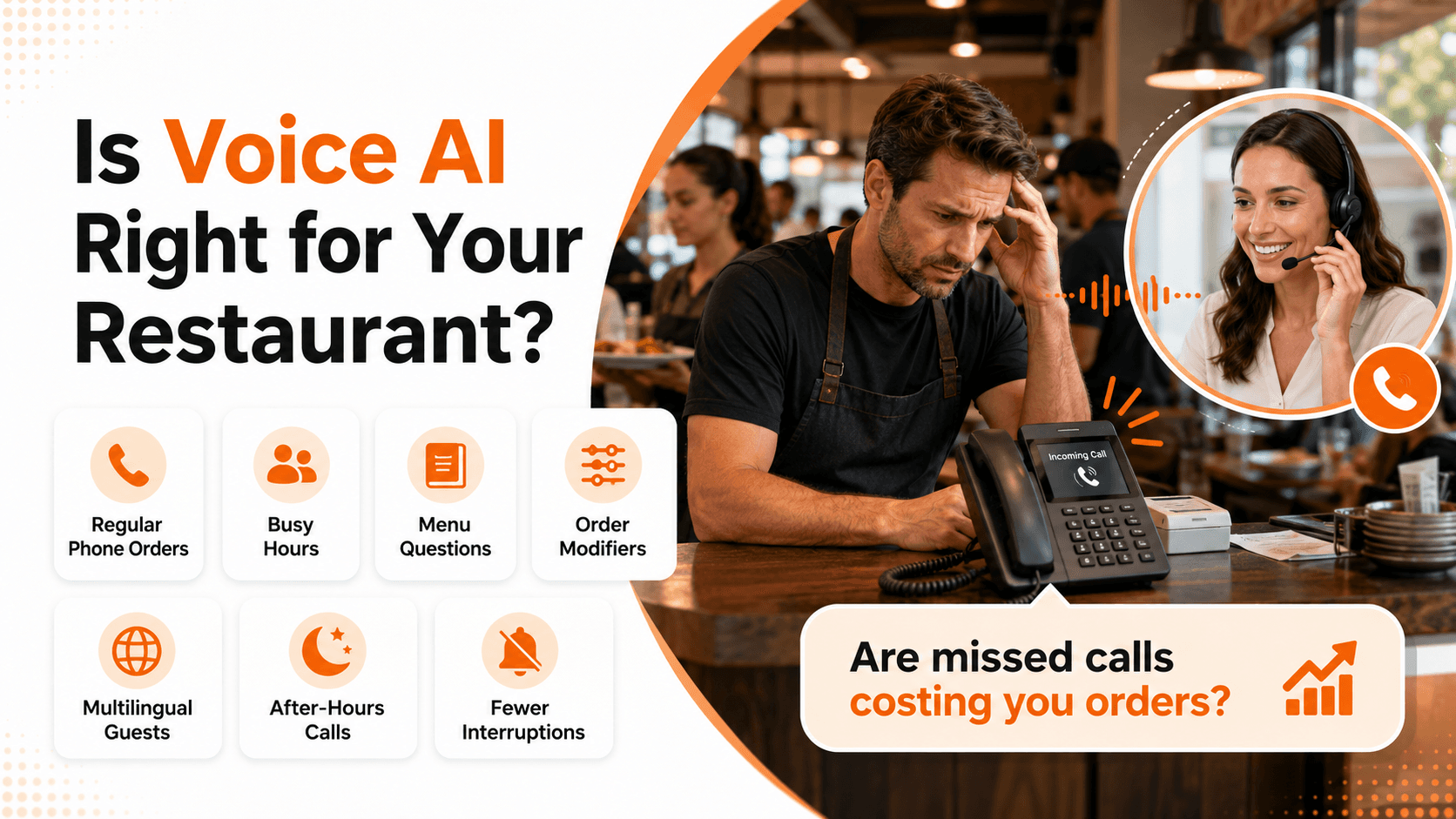
Receive regular phone orders
Have difficulty answering during busy periods
Get frequent menu questions
Handle detailed modifiers
Serve multilingual customers
Receive calls after hours
Want to reduce routine phone interruptions
A restaurant with very little phone traffic may have different priorities.
A useful question for owners is:
What happens when someone calls your restaurant during your busiest hour?
If calls regularly go unanswered or staff frequently have to stop another task to answer them, improving the phone experience may be worth considering.
Where SnapMenuAI VoiceAI fits
Once a restaurant decides that phone calls are creating a real operational problem, it can begin evaluating a restaurant-focused solution.
SnapMenuAI VoiceAI can be configured to support restaurant phone ordering, menu-aware conversations, modifiers, menu guidance, reservation requests, multilingual conversations, payment-link workflows, SMS confirmations, supported POS workflows, call transfer, and after-hours experiences.
The exact experience depends on the restaurant's menu data, operating rules, payment setup, configuration, and supported integrations.
For restaurants that also want customers to order conversationally through text, SnapMenuAI SMS AI provides a separate SMS ordering experience.
Make restaurant phone calls easier to manage
The restaurant phone is still an important way for customers to reach your business.
Some callers need information. Some need help deciding what to order. Others are already ready to buy.
The challenge is making sure those customers can get help when the restaurant team is busy.
Voice AI gives restaurants another way to manage that demand. It can handle routine orders and questions, help customers understand the menu, and keep staff available for the work that needs their attention.
When the phone rings, the restaurant should have a way to respond even when the team is already busy.
See how SnapMenuAI VoiceAI works
Explore SnapMenuAI VoiceAI for restaurants to see how restaurant phone ordering, menu conversations, customizations, reservations, and supported workflows can be handled.
Frequently asked questions
Can AI take restaurant orders over the phone?
Yes. Restaurant Voice AI can capture supported menu items, quantities, modifiers, customizations, and customer requests through a phone conversation before confirming the order.
What is an AI phone ordering assistant?
An AI phone ordering assistant is a voice system that can answer restaurant calls, understand customer requests, use configured menu information, collect order details, and support the next step in the restaurant's ordering process.
Can Voice AI for restaurants understand the menu?
Yes, when accurate restaurant menu information has been configured. The system can use information about items, prices, sizes, modifiers, and available options during customer conversations.
Can AI recommend food to restaurant customers?
Yes. When appropriate menu information is configured, Voice AI can help customers explore available choices based on what they are looking for, such as vegetarian dishes, vegan choices, or spicy food.
Can AI answer questions about ingredients and allergens?
Voice AI can provide configured ingredient and allergen information. Restaurants should maintain accurate menu data and use staff escalation when a customer needs additional allergy-related clarification.
Can AI phone answering work with a restaurant POS?
It can work with supported POS workflows when the necessary integration and configuration are available. Restaurants should confirm compatibility with their specific POS environment.
Can customers still talk to restaurant staff?
Yes. Restaurants can configure call transfer or escalation for conversations that require human assistance.
Does Voice AI replace restaurant employees?
No. Voice AI is best suited to structured, repeatable conversations. Restaurant employees remain important for hospitality, judgment, exceptions, complaints, and situations requiring personal assistance.